AI Transformation 2026: Enterprise Adoption Expands as Governance, Talent, and Scaling Gaps Shape Digital Payments and E-Commerce
By 2026, artificial intelligence has moved from early experimentation to structural infrastructure across global digital payments and E-Commerce ecosystems. Workplace adoption has reached mainstream levels, with AI embedded in customer interaction, fraud management, operational automation, and decision support. Yet while usage continues to expand rapidly, enterprise-wide transformation remains uneven. Differences in governance maturity, infrastructure readiness, and workforce capability are shaping how effectively organizations convert AI adoption into measurable business value. Across regions, AI is no longer defined by isolated pilots or innovation teams. Instead, it is increasingly integrated into daily enterprise workflows, supporting real-time payments, personalized commerce experiences, and automated financial operations. However, the transition from adoption to scalable integration remains one of the defining challenges of the global AI transformation.
Mainstream Workplace Adoption Signals Structural Shift
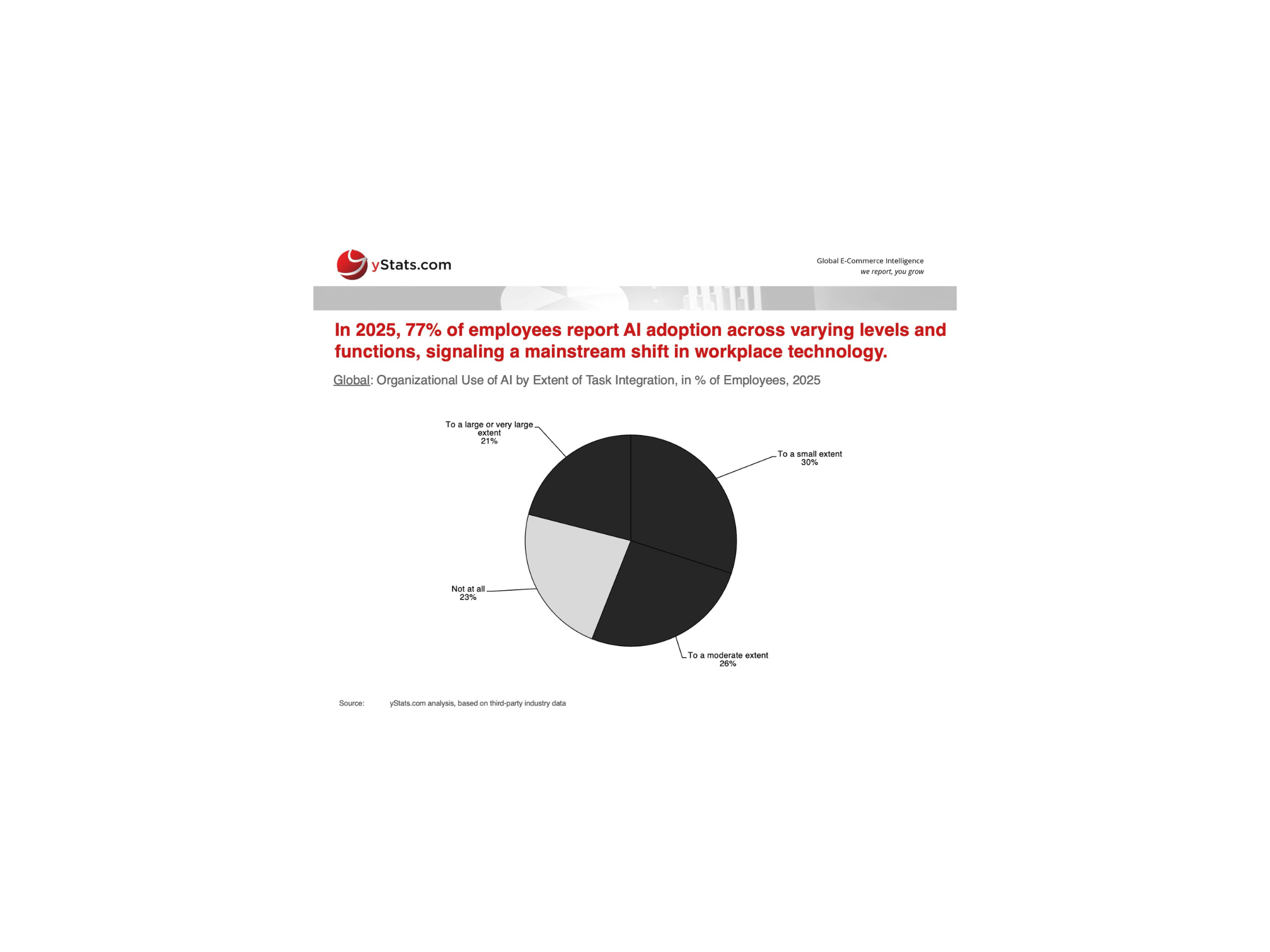
AI adoption in professional environments reached a global tipping point in 2025. More than 75% of employees worldwide reported using AI at work, while over 55% reported regular workplace usage, according to KPMG, confirming that AI has become a mainstream enterprise tool rather than a niche technology.
Despite this widespread exposure, integration depth remains uneven. Emerging markets recorded higher workplace adoption rates, with less than 75% of employees reporting AI use compared to nearly 50% in advanced economies, as per KPMG, yet deployments often remain limited to single-function use cases or early pilots. This contrast highlights a key structural theme: adoption breadth does not necessarily translate into enterprise maturity. Many organizations are experimenting with AI tools, but fewer have fully embedded them into end-to-end operating models that drive sustained productivity gains.
AI Reshapes Digital Payments Through Automation and Security
Within digital payments, AI is increasingly central to fraud detection, compliance monitoring, and real-time decision-making. Financial institutions are shifting from reactive risk management toward automated, AI-driven security systems that continuously analyze transaction patterns and reduce fraud exposure. Organizations are prioritizing scalable AI platforms focused on security, operational resilience, and automation as digital payment volumes continue to expand.
As real-time payment infrastructure grows globally, AI is becoming a foundational layer supporting faster transactions and improved customer protection. However, scaling AI introduces new governance pressures. In North America, leading barriers to generative AI adoption include data quality challenges, privacy concerns, and skills gaps, demonstrating how trust and compliance issues continue to shape enterprise readiness.
AI is also reshaping B2B payments and embedded finance environments, enabling automation across enterprise software systems and strengthening financial workflows. These developments highlight AI’s role not only as a technological innovation but as a structural component of modern payment infrastructure.
Personalization and Consumer-Facing AI Redefine E-Commerce Engagement
Beyond backend operations, AI is reshaping customer experience across digital commerce. In 2024, the majority of global consumers indicated openness to receiving generative AI recommendations while shopping, reflecting growing acceptance of AI-driven personalization tools.
Retailers and marketplaces are expanding AI use across product recommendations, virtual assistants, multilingual support, and dynamic content generation. These technologies help reduce cart abandonment, improve conversion rates, and create more adaptive shopping environments. As commerce platforms integrate generative AI into search, discovery, and checkout experiences, personalization is evolving from a competitive advantage into a baseline expectation.
However, consumer adoption is not uniform across regions. Trust and acceptance levels vary significantly, particularly in parts of Europe and Africa where confidence in AI systems remains relatively low. This adoption–trust gap highlights the importance of governance, transparency, and responsible deployment as AI becomes more visible in customer-facing environments.
Regional Divergence Highlights Scaling Challenges
AI adoption and readiness vary widely across global markets. North America continues to lead in experimentation and investment, with nearly half of firms using generative AI for text generation and workflow automation, yet only a quarter achieving full enterprise-level integration, underscoring persistent execution gaps, according to RSM.
Europe is advancing regulatory frameworks and risk-based governance models, but rising AI-driven fraud and uneven public trust remain challenges. Asia-Pacific markets demonstrate rapid infrastructure investment and ecosystem expansion, while emerging regions such as Latin America and the GCC show strong adoption ambition but face structural constraints related to talent and technology readiness.
Across markets, enterprise readiness increasingly depends on sustained investment in cloud infrastructure, workforce training, and regulatory alignment. More than half of organizations globally cite talent shortages as a primary barrier to scaling AI, reinforcing the need for long-term capability development rather than short-term experimentation.
From Adoption Metrics to Enterprise Transformation
As AI adoption accelerates, organizations are shifting focus from experimentation toward measurable productivity and efficiency gains. Global technology spending continues to rise, supported by expanding investment in AI, cloud infrastructure, and fintech innovation. The global AI in fintech market is projected to grow from over USD 18 billion in 2025 to more than USD 50 billion by 2030, reflecting the increasing strategic importance of AI within digital commerce ecosystems.
Leading enterprises are integrating AI into customer onboarding, multilingual support, fraud detection, and operational analytics, enabling faster decision-making and more personalized user experiences. Yet the benefits of AI scaling remain uneven across regions and industries, highlighting the growing divide between early adopters with mature governance frameworks and organizations still navigating strategy and compliance challenges.
Conclusion
AI transformation in 2026 reflects a global digital economy transitioning from experimentation to enterprise integration. Workplace adoption is widespread, investment is accelerating, and AI is increasingly embedded across payments, E-Commerce, and enterprise operations. However, governance gaps, talent shortages, and infrastructure readiness continue to shape how effectively organizations scale AI at a global level.
As digital payments and commerce environments become more data-driven and real-time, AI will play a central role in defining operational resilience, fraud prevention, and customer experience. The next phase of AI transformation will not be defined by adoption rates alone, but by how successfully organizations align technology, governance, and workforce development to build sustainable, scalable digital ecosystems.