Africa’s B2C E-Commerce & Payments Landscape: Mobile Infrastructure, Payments Scaling, and Structural Constraints
Africa’s B2C E-Commerce and digital payments markets are expanding in tandem, supported by mobile-first connectivity, demographic momentum, and the growing role of fintech platforms. While digital adoption remains uneven across countries, structural foundations for long-term scale are increasingly in place. Smartphone adoption, instant payment infrastructure, and platform-based business models are extending digital commerce beyond the reach of traditional retail and banking systems, shaping a distinct trajectory for Africa’s digital economy.
Digital Infrastructure Is Expanding Africa’s Addressable E-Commerce Market
Africa’s B2C E-Commerce growth is structurally enabled by mobile-first connectivity and rising smartphone adoption. In Sub-Saharan Africa, almost 30% of the population was connected to mobile internet in 2024, highlighting a large untapped digital user base, according to GSMA. At the same time, smartphone adoption is projected to rise from over 50% of total mobile connections in 2024 to more than 80% by 2030, significantly expanding the mobile-first digital addressable market.
Growth in mobile internet subscribers between 2025 and 2030 is forecast to be concentrated in a limited number of high-population markets, led by Nigeria and Ethiopia. This concentration reinforces scale effects in key economies, while uneven infrastructure quality continues to shape differences in digital readiness across countries.
Alongside connectivity expansion, fintech and non-bank entrants are reshaping competitive dynamics across digital commerce and payments. Lower cost structures, faster innovation cycles, and platform-based partnerships allow these players to operate with greater agility than traditional banks and retailers. Platform and ecosystem models are increasingly replacing vertically integrated structures, with governance frameworks and partner participation emerging as key determinants of sustainable digital scale.
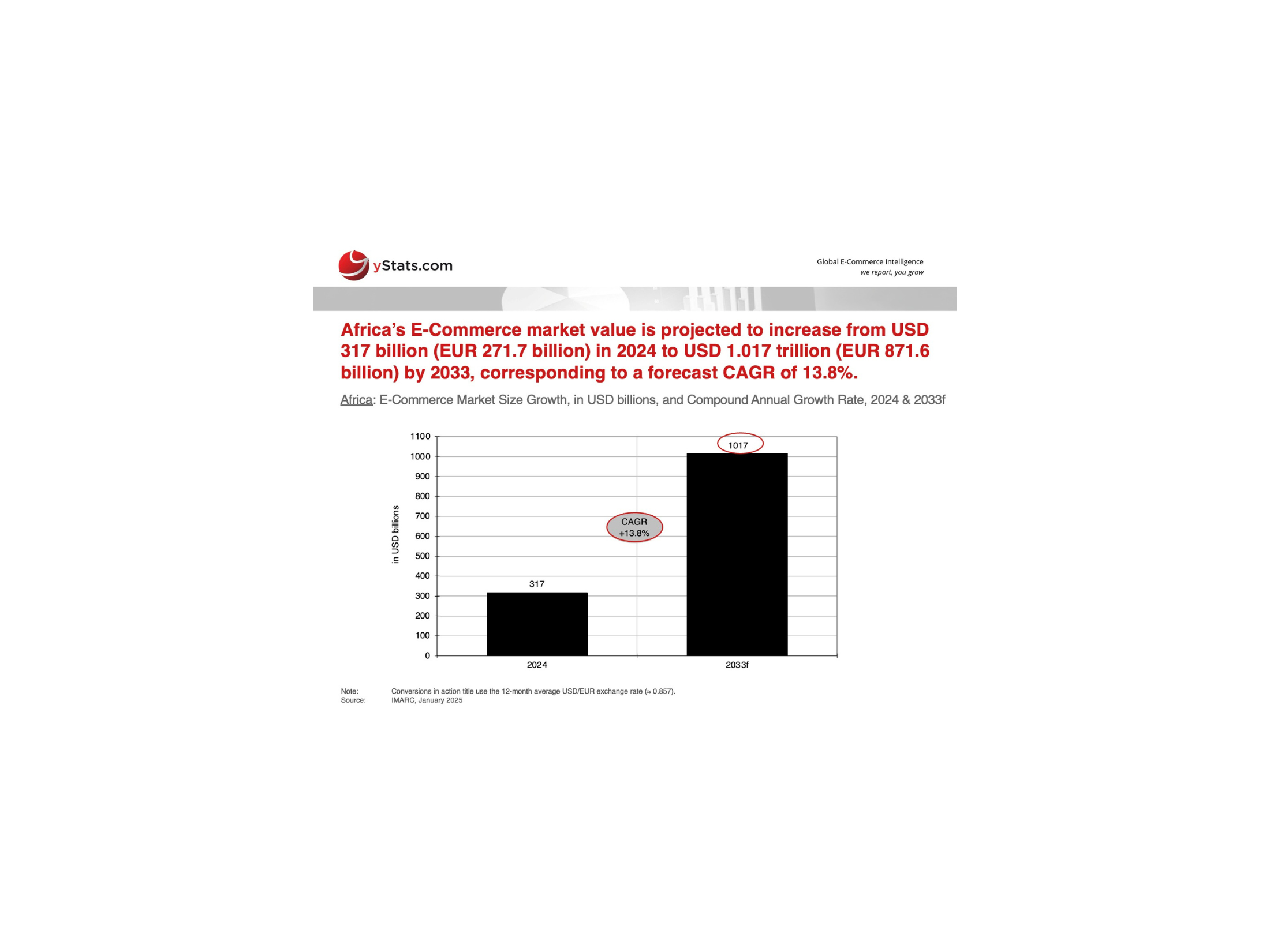
Africa’s B2C E-Commerce Market Is Forecast to Surpass USD 1 Trillion by 2033
Africa’s E-Commerce market value is forecast to grow from over USD 300 billion in 2024 to more than USD 1 trillion by 2033, corresponding to a compound annual growth rate of nearly 14%, according to IMARC. B2C remains the dominant business model across the region, supported by rising smartphone penetration, expanding internet access, and increasing consumer familiarity with online shopping platforms.
Market activity is concentrated in essential services and everyday retail. Financial services and E-Tailing represent the most prominent E-Commerce service types, while apparel and consumer electronics account for the largest share of online product sales. This distribution indicates that Africa’s E-Commerce growth is driven primarily by functional and necessity-based demand rather than discretionary or experience-led spending.
At the country level, the market remains highly fragmented. South Africa leads Africa’s E-Commerce market in scale and maturity, followed by Nigeria and Egypt, while many other countries account for smaller shares due to differences in infrastructure, logistics capability, and consumer trust. Despite this fragmentation, smartphone adoption and fintech expansion continue to support growth across a wide range of markets.
Mobile and Instant Payments Are Becoming Core Transaction Infrastructure
Africa’s payments ecosystem has evolved through structural leapfrogging, with mobile payments replacing cash as the primary transaction infrastructure rather than following a gradual card-based adoption path. Mobile payments have expanded beyond person-to-person transfers to support E-Commerce, business, and government transactions, embedding digital payments into everyday economic activity.
Instant payment systems now function as one of the core infrastructures of Africa’s digital payments ecosystem. By mid-2025, 36 instant payment systems were operating across 31 African countries. Transaction volumes exceeded 64 billion by 2024, while total transaction values approached USD 2 trillion, as per AfricaNenda Foundation, reflecting rapid adoption and growing habitual use.
Despite this expansion, interoperability remains uneven. Person-to-person transfers remain the most widely supported use case, while merchant, business, government, and cross-border payments show more limited system-level coverage. Differences in system architecture, participation rules, and governance structures continue to constrain unified market functionality.
Liquidity, Settlement, and Trust Constraints Limit Payments Scalability
As digital payments scale, liquidity management, settlement speed, and execution-layer risks increasingly determine system sustainability. Structural liquidity fragmentation across currencies and jurisdictions inflates working capital requirements and increases settlement risk. While real-time settlement mechanisms improve intraday liquidity utilization, regulatory fragmentation and infrastructure gaps continue to constrain cross-border scalability.
Trust-related concerns further limit adoption intensity. Digital payment usage continues to coexist with cash, as fraud perceptions, usability gaps, and reliability issues constrain deeper usage among both consumers and merchants. As a result, expanding system access alone has not translated into fully cashless behavior across African markets.
South Africa Demonstrates Structural Maturity in Digital Commerce
South Africa illustrates how resolving infrastructure and execution constraints enables E-Commerce to reach structural scale. Between 2020 and 2025, South Africa’s B2C E-Commerce revenue increased from EUR 1.5 billion to over EUR 6 billion, corresponding to a CAGR of 34%, according to World Wide Worx.
Online grocery and FMCG increased transaction frequency, embedding E-Commerce into everyday consumption. Improvements in logistics capability, checkout reliability, and platform performance reinforced market maturity. Nearly three-quarters of South African online retailers reported profitable E-Commerce operations in 2025, and satisfaction with payment gateways remained high.
At the same time, checkout friction, limited adoption of new payment technologies, cybersecurity exposure, and regulatory complexity continue to shape the risk profile of scaling frictionless and cross-border payments, even in more mature markets.
Conclusion
Africa’s B2C E-Commerce and payments markets are scaling together as interconnected systems. Mobile-first infrastructure, demographic momentum, and fintech-led competition are expanding access beyond traditional retail and banking channels. E-Commerce growth is increasingly driven by essential services and everyday consumption, while mobile and instant payments function as the core transaction infrastructure. However, fragmentation in infrastructure, interoperability, regulation, and trust continues to shape the pace and distribution of growth across African markets, pointing to a digital commerce landscape that is expanding rapidly while progressing unevenly toward structural maturity.