Fraud, Scams, and AI Risk in Digital Payments and E-Commerce 2026: Losses Expand as Social Engineering, AI-Driven Attacks, and Ecosystem Complexity Reshape Global Risk
By 2026, fraud and cyber risk have become structural challenges across global digital payments and E-Commerce ecosystems. As digital transactions, real-time payments, and cross-border commerce continue to expand, fraud exposure is increasing in both scale and complexity. At the same time, artificial intelligence is reshaping the threat landscape, enabling more sophisticated scams while also supporting advanced detection capabilities. However, despite rising investment and widespread adoption of fraud prevention technologies, the transition toward effective, system-wide risk mitigation remains uneven. Differences in organizational readiness, governance frameworks, and technological capabilities are shaping how effectively businesses respond to evolving fraud threats. Across global markets, fraud is no longer limited to isolated incidents but is increasingly embedded within the structure of digital commerce, requiring coordinated, ecosystem-level responses.
Rising Fraud Exposure Reflects the Expansion of Digital Commerce and Payment Infrastructure
Fraud losses are increasing alongside the continued growth of digital payments and E-Commerce activity. Global E-Commerce fraud losses are forecast to more than double from over USD 44 billion in 2024 to more than USD 100 billion by 2029, according to Juniper Research, reflecting the growing financial impact of fraud across digital ecosystems.
This growth is closely linked to the expansion of real-time payments, cross-border transactions, and digital financial services. As transaction volumes increase, fraud exposure rises in absolute terms, even as detection capabilities improve. At the same time, fraud is increasingly affecting customer trust, transaction completion, and retention, reinforcing its role as both a financial and operational risk for businesses.
This dynamic highlights a key structural shift: fraud is no longer a byproduct of digital commerce growth but a core constraint shaping its scalability and long-term sustainability.
Social Engineering and Authorized Fraud Are Redefining the Nature of Financial Crime
The structure of fraud is evolving from technical compromise toward manipulation-driven scams. Survey findings indicate that fraud’s share of company revenue increased from 6.5% to 7.7% in 2025, as per TransUnion, highlighting the growing financial burden of fraud across businesses.
These fraud journeys often begin outside traditional payment channels, including social media, messaging platforms, and phone interactions, before culminating in a payment. This shift increases investigative complexity and reduces the effectiveness of traditional transaction-level controls.
As a result, fraud prevention strategies are moving earlier in the customer journey. Organizations are increasingly adopting behavioral analytics, real-time warnings, and cross-channel monitoring to detect risk before transactions occur. This transition reflects a broader industry shift toward proactive and intelligence-led fraud prevention models.
Artificial Intelligence Accelerates Both Fraud Sophistication and Defensive Capabilities
Artificial intelligence is playing a dual role in the evolution of fraud. On the offensive side, generative AI enables scalable phishing campaigns, deepfake impersonation, and automated scam operations, lowering barriers to entry and increasing attack effectiveness.
At the same time, AI is becoming a core component of fraud detection systems. Financial institutions and payment providers are deploying AI-driven tools for transaction monitoring, behavioral analysis, and anomaly detection, improving their ability to identify and prevent fraud in real time.
However, the parallel development of AI-enabled attacks and defenses is increasing pressure on organizations that lack advanced capabilities. Businesses without mature AI-driven risk systems face growing exposure as fraud becomes more automated, adaptive, and data-driven. This widening capability gap is emerging as a key factor shaping competitive resilience in digital commerce.
Consumer Trust Weakens as Fraud Exposure Becomes Widespread
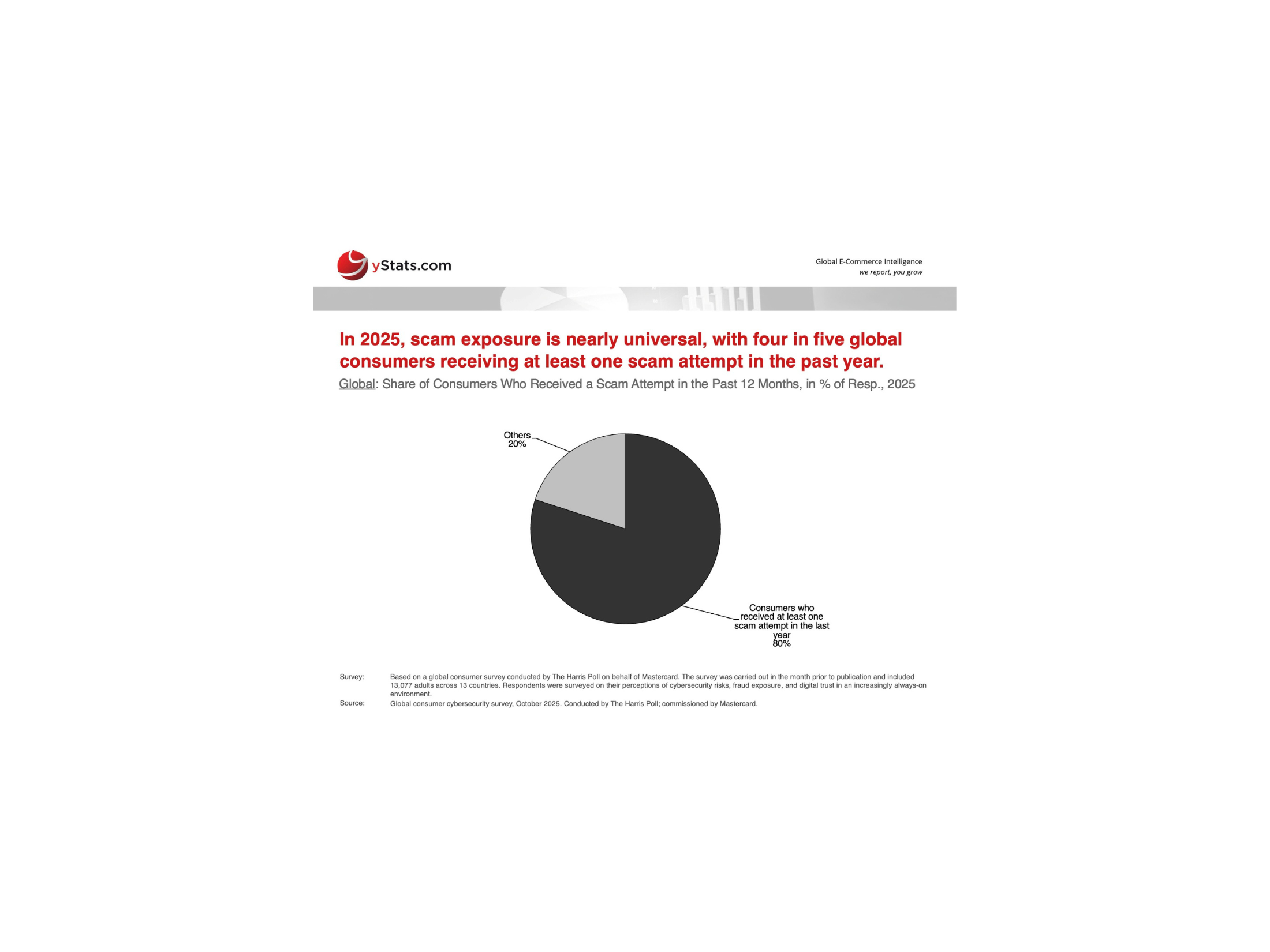
Consumer data indicates that fraud exposure has become nearly universal across digital environments. In 2025, 80% of global consumers reported receiving at least one scam attempt in the past year, according to The Harris Poll, reflecting the scale of exposure to fraud across digital channels.
At the same time, many consumers perceive securing personal data online as more difficult than protecting their physical environment, reinforcing a growing digital trust gap. Behavioral factors such as embarrassment and reluctance to report fraud further complicate prevention and recovery efforts.
These trends suggest that fraud is not only a financial risk but also a structural challenge for consumer trust in digital commerce. As fraud becomes more visible and pervasive, maintaining trust is increasingly dependent on transparency, security, and effective incident response.
Fraud Becomes a Strategic Business Risk Driving Executive and Investment Priorities
Fraud is increasingly treated as a strategic, cross-functional risk rather than a purely operational issue. Industry findings indicate growing executive and board-level attention to fraud management, with organizations integrating fraud considerations into product design, compliance, and customer experience strategies.
Rising reimbursement expectations and liability pressures are increasing the financial burden of fraud incidents, further reinforcing the need for preventive investment. As a result, organizations are expanding enterprise-wide risk governance frameworks and adopting advanced analytics and monitoring systems.
This shift reflects a broader transformation in how fraud is managed: from reactive loss mitigation toward proactive, organization-wide risk management embedded across digital operations.
Security Investment Expands as Fraud Complexity and Regulatory Pressure Increase
Investment in cybersecurity and fraud prevention is accelerating globally as organizations respond to rising threat complexity and regulatory requirements. Forecasts indicate strong growth in security spending, with global information security expenditure expected to increase significantly by 2026.
At the same time, the fraud detection and prevention market is projected to expand rapidly in the coming years, reflecting increasing demand for scalable and automated risk solutions. Investment is also supported by the emergence of a mature ecosystem of technology providers, including identity verification, AML/KYC, and behavioral analytics platforms.
However, increasing investment does not automatically translate into effective risk reduction. Implementation challenges, data limitations, and talent shortages continue to constrain the scalability of fraud prevention systems, highlighting ongoing gaps between investment and operational outcomes.
Regulatory and Ecosystem Developments Emphasize Real-Time Risk Management and Collaboration
Regulators and industry bodies are placing greater emphasis on real-time monitoring, identity verification, and payment pre-validation as core fraud mitigation strategies. These measures are particularly relevant in fast payment systems, where transaction speed increases both convenience and risk.
At the same time, the growing interconnectedness of payment ecosystems is increasing systemic risk. Cloud dependencies, third-party providers, and cross-border transaction flows are creating new vulnerabilities that require coordinated risk management approaches.
As a result, collaboration across financial institutions, fintechs, merchants, and regulators is becoming a central component of fraud prevention. Intelligence sharing and coordinated response mechanisms are increasingly viewed as essential to addressing organized cybercrime and cross-border fraud networks.
Conclusion
Fraud and cyber risk in 2026 reflect a digital economy in which financial crime is evolving alongside technological innovation and payment system expansion. Fraud losses are rising, scam models are becoming more sophisticated, and artificial intelligence is reshaping both attack and defense capabilities across digital commerce ecosystems.
At the same time, organizations are increasing investment, strengthening governance frameworks, and adopting advanced detection technologies. However, gaps in capability, trust, and coordination continue to limit the effectiveness of these efforts at scale.
The next phase of fraud management will not be defined by detection capabilities alone, but by how effectively organizations integrate technology, governance, and ecosystem collaboration to build resilient, trust-based digital payment and commerce environments.