North America’s Market Landscape 2026: Platform Expansion, Payments Evolution, AI Integration, and B2B Digital Trade
North America’s digital economy is entering a period of continued structural transformation. By 2026, B2C E-Commerce is expanding steadily, digital payments are shifting toward wallet-based and real-time methods, artificial intelligence is becoming embedded across business operations, and B2B commerce is moving decisively online. These changes are being driven by evolving consumer behavior, platform consolidation, automation, and the growing digitization of procurement and supply chains. At the same time, rising trade tensions, regulatory complexity, uneven AI readiness, and fragmented payment adoption are shaping the pace and direction of progress across the region. Together, these forces are redefining how companies and consumers interact in North America’s digital marketplace.
B2C E-Commerce: Steady Growth with Platform Consolidation and Tariff Pressures
North America’s B2C E-Commerce market continues to expand at a stable pace, led primarily by the United States. U.S. online retail sales are projected to surpass USD 1.5 trillion by 2028, reflecting annual growth of around 8–9%, according to eMarketer. Online channels are projected to account for an increasingly larger portion of retail activity in the coming years, reflecting the growing integration of digital platforms into everyday consumer purchasing habits. E-Commerce is expected to capture a steadily rising share of overall B2C sales, highlighting a sustained structural shift toward online commerce as a central component of the retail landscape.
Market concentration is intensifying. By 2029, Amazon and Walmart are projected to account for roughly two-thirds of all U.S. online retail sales, generating combined revenues of more than USD 1 trillion, according to Forrester Research. This dominance reflects the strategic advantages of large-scale logistics networks, integrated payment ecosystems, and expansive digital marketplaces. Social commerce is also gaining relevance, particularly among younger consumers. In 2023, over 70% of U.S. Gen Z shoppers reported making purchases directly on Instagram, highlighting the growing role of social platforms as transactional channels, as per Jungle scout.
Canada’s E-Commerce trajectory remains positive but more moderate. Online retail sales are forecast to reach CAD 130 billion by 2027, while the E-Commerce share of total retail sales is expected to rise only slightly, according to eMarketer. The slower growth reflects a more mature market structure and differing consumer adoption patterns compared with the U.S.
Trade policy has become an increasingly influential factor shaping the market environment. Recent tariff measures have raised operational costs and added complexity to cross-border supply chains, with smaller online retailers particularly affected. Depending on the intensity of tariff pressures, overall E-Commerce growth could be significantly constrained, creating a more challenging operating climate for digital merchants. In response, retailers are being driven to diversify their sourcing strategies, invest in automation tools, and reconsider pricing models in order to remain competitive.
Payments: Digital Wallet Momentum Meets Persistent Card Dominance
North America remains one of the world’s largest payments markets, but its structure is gradually evolving. The region is forecast to account for more than 25% of global payments revenues by 2027, according to McKinsey & Companu. Growth, however, is expected to be more moderate than in emerging regions such as Latin America and Asia-Pacific, indicating a maturing market landscape.
Cards continue to dominate the payments landscape in terms of revenue generation. Traditional card payments represent the largest share of the regional payment mix, with credit cards serving as a particularly significant contributor to overall payments income. Debit cards remain the most commonly used method for everyday transactions, consistently selected by consumers as their primary payment option for routine purchases.
At the same time, digital wallets are steadily gaining traction among consumers. Adoption continues to rise as more shoppers integrate wallet-based payments into their everyday purchasing behavior. Usage patterns vary across channels: global wallet providers such as PayPal are more commonly used for online and in-app transactions, while OEM wallets like Apple Pay tend to be favored for in-store payments. Despite this growing momentum, challenges remain, including uneven merchant acceptance and fragmented consumer loyalty across multiple competing platforms.
Alternative payment methods are also expanding. Buy Now, Pay Later (BNPL) services are gaining traction, and mobile-first payment experiences are becoming more common in digital commerce. However, cash has not disappeared entirely, and structural reliance on established payment rails continues to slow the full transition toward new payment models. The result is a hybrid ecosystem in which innovation accelerates, but legacy systems retain significant influence.
Artificial Intelligence: Rapid Uptake with Governance and Readiness Gaps
Artificial intelligence is becoming a central driver of digital transformation across North America. A growing share of organizations in the region are now using generative AI for text-based applications as well as for forecasting and analytics. Levels of partial AI integration are steadily increasing, reflecting a broader shift from early experimentation toward more structured and operational deployment of AI technologies within everyday business processes.
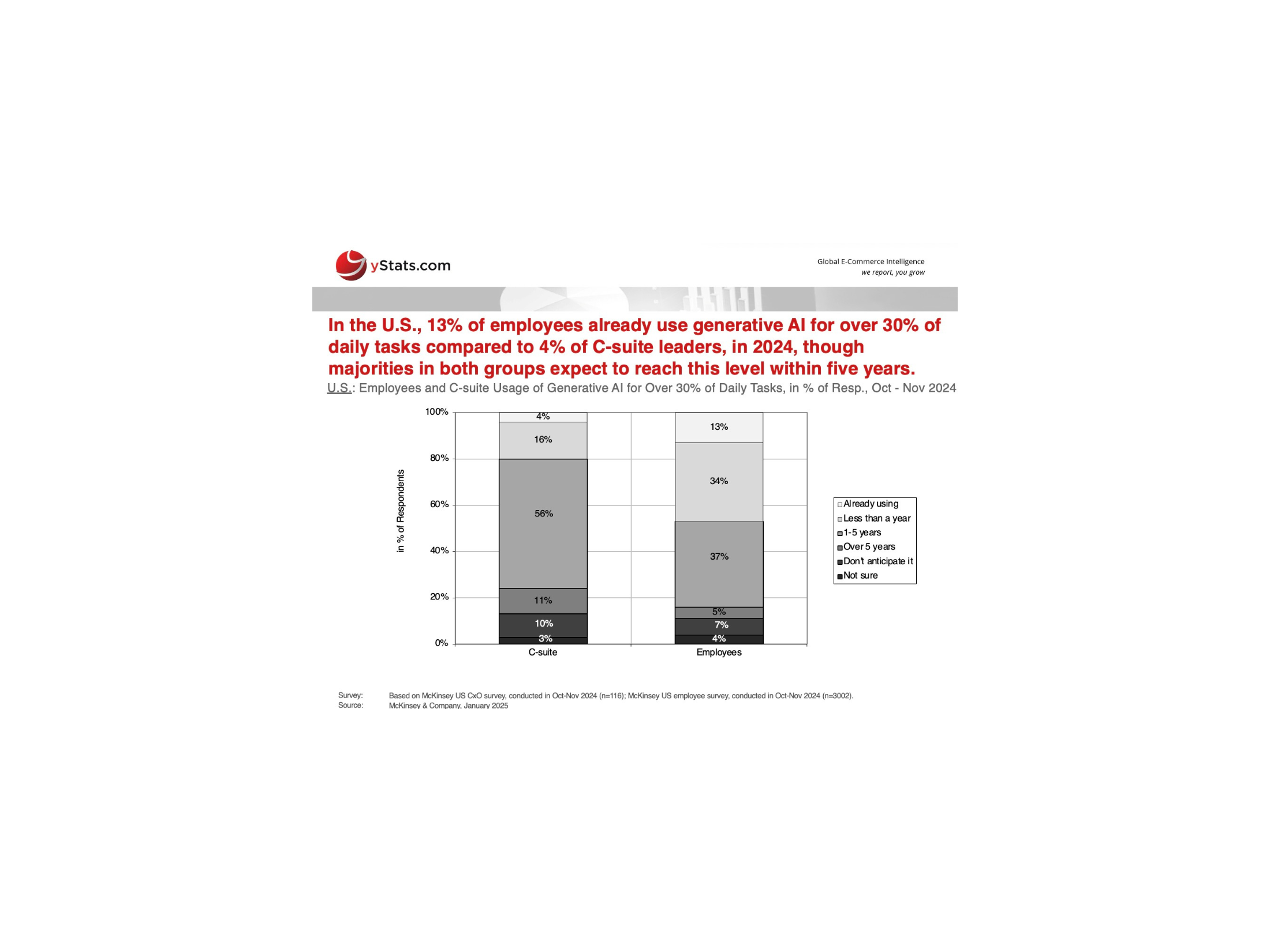
The United States is leading this transition. Over 30% of daily tasks in some U.S. companies now involve generative AI support, and firms are increasingly using AI for fraud prevention, personalization, and payment automation, as per McKinsey & Company. In financial services, AI is being applied to cybersecurity, customer engagement, and risk management, reinforcing its role as a foundational technology within the payments ecosystem.
Canada’s AI adoption is progressing more gradually. While awareness and experimentation are rising, many organizations remain in early proof-of-concept stages. Regional disparities in funding, talent availability, and policy frameworks are shaping uneven adoption patterns across provinces and industries.
Scaling AI remains a significant challenge for many organizations. North American firms frequently cite issues such as data quality limitations, privacy concerns, and shortages of skilled talent as major obstacles to broader implementation. While most organizations intend to increase investment in AI initiatives, only a small portion have fully established responsible AI frameworks to govern their use. These gaps highlight the ongoing difficulty of moving beyond pilot projects and translating AI experiments into sustainable, enterprise-wide transformation.
B2B E-Commerce: Digital Procurement Gains Momentum
B2B commerce in North America is undergoing its own digital transformation. U.S. B2B E-Commerce sales have expanded rapidly in recent years, reflecting a strong acceleration in online commercial activity since the late 2010s. Online channels are expected to represent a steadily growing share of overall B2B sales in the coming years, signaling a clear and ongoing shift toward digital procurement and more technology-driven purchasing processes.
Marketplaces are playing an increasingly important role in the B2B landscape. B2B marketplace sales in the United States have expanded rapidly, reflecting strong momentum in platform-based purchasing. Amazon Business has emerged as a leading platform in this space, attracting a large share of corporate buyers and becoming a central channel for business procurement. A growing number of major buyers are now conducting significant portions of their purchasing through marketplace platforms, underscoring their rising strategic importance.
Adoption, however, remains uneven. Many companies in North America report that only a small portion of their purchases are currently made through B2B marketplaces, indicating that usage is still largely exploratory rather than fully integrated into procurement processes. Nearly half of firms still prefer traditional purchasing channels, reflecting ongoing skepticism and workflow inertia.
Conclusion
North America’s digital commerce ecosystem is expanding across multiple dimensions. B2C E-Commerce continues to grow steadily, though shaped increasingly by platform concentration and tariff-related uncertainty. Payments are shifting toward digital wallets and mobile solutions, even as cards remain central to revenue generation. Artificial intelligence is being embedded into everyday business processes, but structural barriers continue to limit full-scale deployment. Meanwhile, B2B commerce is digitizing rapidly, with marketplaces and automated procurement tools redefining how companies buy and sell.
The region’s digital future will depend on its ability to navigate trade volatility, modernize payment infrastructure, develop responsible AI frameworks, and improve the usability of B2B platforms. How effectively businesses adapt to these intersecting trends will determine North America’s competitive position in an increasingly digital global economy.