Global Digital Commerce 2026: B2C E-Commerce Expansion, Payments Innovation, AI Adoption, and the Rise of B2B Marketplaces
By 2026, global digital commerce is entering a structurally mature phase defined by rising transaction intensity, infrastructure modernization, and expanding enterprise adoption of artificial intelligence. B2C E-Commerce continues to scale across regions, supported by mobile-first consumer behavior and cross-border demand, while digital payments evolve through real-time infrastructure and diversified payment methods. At the same time, AI is shifting from experimentation to operational deployment, and B2B marketplaces are transforming procurement and trade relationships. Together, these forces are redefining how consumers shop, how businesses transact, and how global digital markets compete, as digital ecosystems become more interconnected and strategically driven.
B2C E-Commerce Expands Through Transaction Intensity and Cross-Border Demand
Global B2C E-Commerce growth is increasingly driven by higher purchase frequency and cross-border activity rather than rapid expansion of the online shopper base. Retail E-Commerce sales are projected to rise from over USD 6 trillion in 2024 to nearly USD 8 trillion by 2027, according to eMarketer, reflecting steady structural expansion across both mature and emerging markets. Online penetration is also increasing, with retail E-Commerce forecast to account for over 20% of global retail sales by 2027, underscoring the continued integration of digital channels into everyday consumption. Growth patterns vary by region, with Asia-Pacific continuing to lead in scale, while North America and Western Europe demonstrate more moderate but stable expansion as markets mature.
Cross-border shopping remains a central growth driver. In 2024, over 50% of global online shoppers purchased from foreign retailers, as per DHL, primarily motivated by lower prices and wider product variety. Social commerce is accelerating alongside this trend, with nearly half of global consumers shopping through social platforms monthly, reinforcing the importance of mobile-first engagement and integrated checkout experiences. However, high delivery costs, regulatory complexity, and fraud concerns remain significant barriers, shaping conversion rates and consumer trust across regions. As digital commerce matures, competitive differentiation is shifting toward logistics efficiency, platform integration, and improved customer experience rather than simply expanding online access.
Digital Payments Enter a High-Volume, Multi-Method Phase
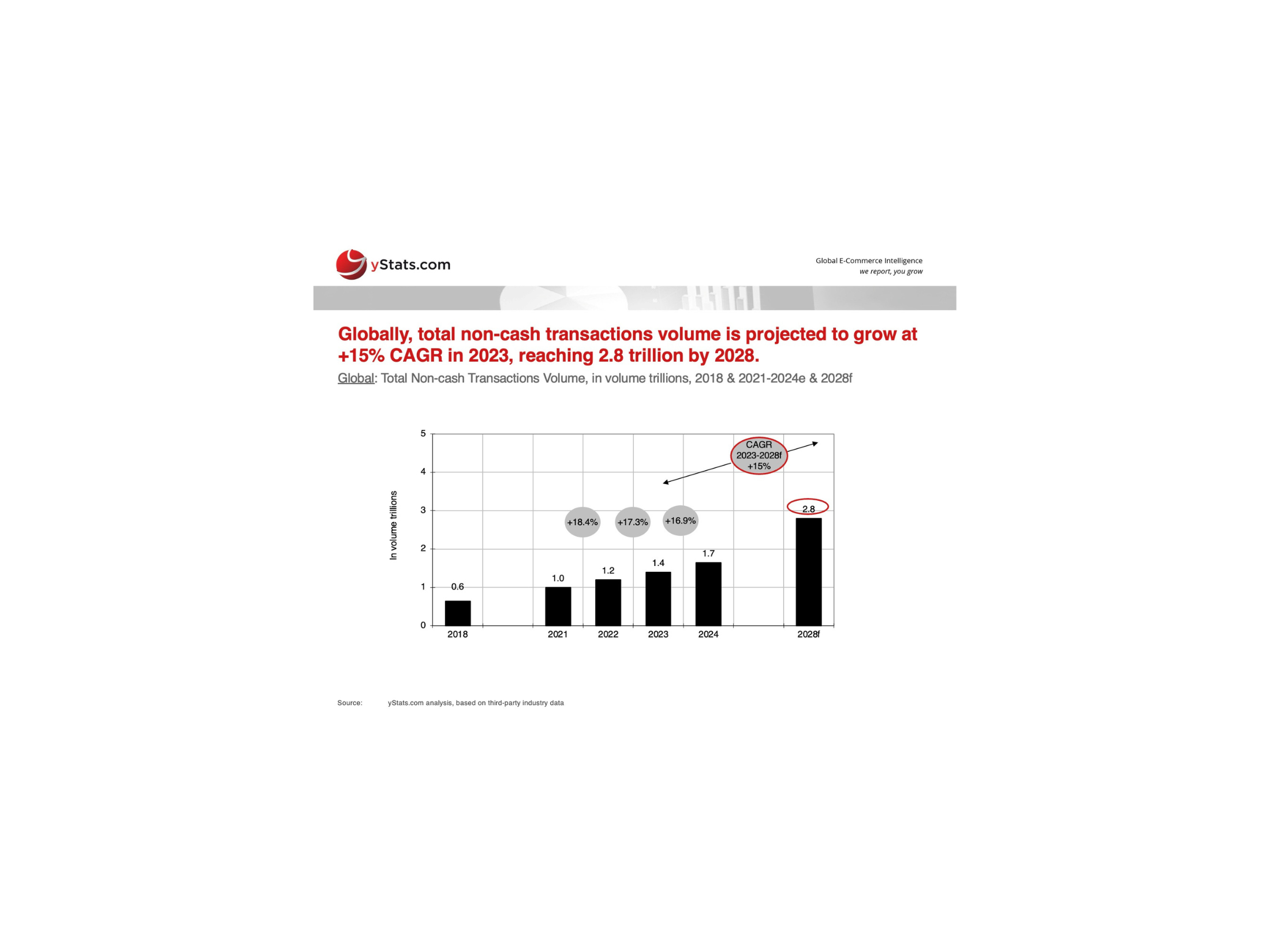
Global payment ecosystems are evolving rapidly as non-cash transactions expand across both consumer and B2B segments. Total global non-cash transaction volumes are projected to grow at a +15% CAGR, reaching around 2.8 trillion transactions by 2028, according to Capgemini Research Institute, signaling a structural shift away from cash and toward digital-first financial ecosystems. Instant payment systems and digital wallets are increasingly reshaping transaction behavior, particularly in mobile-first markets, while traditional card infrastructure continues to dominate revenue generation in mature economies where established networks remain deeply embedded.
Regional divergence is becoming more pronounced. Asia-Pacific leads in digital wallet penetration and transaction scale, while North America remains a major revenue contributor, expected to account for roughly 25% of global payments revenue by 2027, according to McKinsey & Company. Europe continues to advance omnichannel payment experiences, integrating digital wallets with traditional banking infrastructure, while emerging markets are leveraging mobile payments to accelerate financial inclusion. At the same time, commercial and B2B payments are gaining importance, driven by automation and digitization of procurement processes. As payment ecosystems diversify, competitive advantage increasingly depends on interoperability, real-time settlement capabilities, and fraud resilience, with payment providers investing heavily in infrastructure modernization.
Artificial Intelligence Moves from Experimentation to Enterprise Infrastructure
Artificial intelligence is becoming a central driver of digital commerce transformation, embedded across customer experience, fraud prevention, marketing automation, and operational decision-making. By 2025, more than 75% of employees globally reported some level of AI usage at work, as per KPMG, highlighting its rapid transition into mainstream enterprise workflows. Generative AI adoption is also accelerating, with organizations expanding investment and integrating AI into analytics, content creation, and predictive modeling. Across commerce and payments environments, AI-driven personalization and automation are enabling more efficient customer engagement and improved transaction security.
Despite widespread adoption, structural challenges persist. Only a minority of firms have implemented comprehensive governance frameworks, and workforce readiness remains uneven across regions and industries. Data strategy is cited as a major challenge by nearly half of C-suite leaders, reflecting the complexity of scaling AI responsibly within large organizations. Differences in regulatory maturity and infrastructure readiness continue to shape uneven adoption patterns globally. As AI continues to reshape payments and E-Commerce ecosystems, long-term competitive advantage will depend less on adoption itself and more on governance alignment, workforce training, and strategic integration into enterprise operations.
B2B Commerce and Marketplaces Reshape Global Trade Dynamics
B2B E-Commerce is undergoing significant structural transformation as digital marketplaces, automation tools, and embedded finance solutions reshape procurement workflows. Global B2B E-Commerce gross merchandise value is projected to reach over EUR 35 trillion by 2026, according to Edgar Dunn & Company, highlighting the scale of digital trade expansion and the increasing importance of online procurement channels. Marketplace adoption is accelerating across industries, supported by improved logistics integration, enhanced supplier discovery tools, and the demand for greater operational efficiency.
However, adoption remains uneven. While nearly 75% of global B2B buyers research products online, many organizations still rely on traditional procurement channels due to concerns about data quality, product transparency, and workflow complexity. Payment innovation is playing an increasingly important role, with virtual cards projected to grow, enabling more automated and secure transactions. As buyer expectations evolve toward seamless digital experiences and real-time visibility, the future growth of B2B commerce will depend on improving interoperability, strengthening platform trust, and integrating end-to-end procurement capabilities that align with enterprise workflows.
Conclusion
Global digital commerce in 2026 is defined by structural evolution rather than rapid disruption. B2C E-Commerce continues to expand through transaction intensity and cross-border engagement, while digital payments shift toward real-time infrastructure and diversified payment methods. Artificial intelligence is becoming embedded across enterprise operations, though governance and workforce readiness remain critical challenges. Meanwhile, B2B marketplaces are redefining procurement and global trade through automation, digital platforms, and new payment innovation.
As these trends converge, the next phase of digital commerce will be shaped by how effectively organizations integrate AI, payments infrastructure, and digital trade platforms into cohesive ecosystems. Markets that can align technology, strategy, and user experience will be best positioned to sustain long-term competitiveness in an increasingly interconnected global economy, where digital infrastructure and enterprise transformation are becoming central drivers of long-term growth.