Global B2C E-Commerce, Payments, and AI Forecast 2026: Structural Maturity and Transaction-Led Growth
Global digital commerce is increasingly shaped by scale, transaction intensity, and system-level integration rather than rapid adoption alone. As B2C E-Commerce, digital payments, and artificial intelligence evolve together, their interaction is redefining how online transactions are processed, financed, and supported across regions. The following analysis examines these developments across global and regional markets, focusing on how structural maturity is influencing growth dynamics within digital commerce ecosystems.
Global B2C E-Commerce Growth Moderates as Penetration Stabilizes Across Mature Markets
Global B2C E-Commerce continues to expand, although growth dynamics are evolving. B2C E-Commerce share is forecast to rise steadily through 2027, reflecting the continued normalization of online purchasing within total retail activity. However, penetration gains are moderating across developed markets, indicating that global E-Commerce growth is increasingly driven by higher transaction frequency and sustained consumer demand rather than by rapid expansion of the online shopper base.
Asia-Pacific remains the primary contributor to global E-Commerce scale. B2C E-Commerce sales in the region are forecast to reach over USD 4 trillion by 2028, reinforcing its position as the world’s largest digital commerce market, according to eMarkter. Growth continues to be anchored by China, South Korea, Japan, India, and Australia, where large consumer bases and established digital ecosystems support high transaction volumes and platform-led expansion.
In North America and Europe, B2C E-Commerce growth reflects a more mature market environment. Online retail penetration continues to increase, but at a measured pace, as digital channels are already deeply embedded in consumer purchasing behavior. In these regions, growth is increasingly supported by repeat purchasing, omnichannel retail strategies, and improvements in logistics and payment infrastructure rather than first-time digital adoption.
Emerging regions contribute incremental growth from smaller base levels. In Latin America, the Middle East, and Africa, rising internet access, mobile usage, and platform development continue to support E-Commerce expansion. While absolute market size remains lower than in Asia-Pacific or North America, these regions play a growing role in global E-Commerce volume growth as digital retail adoption broadens across new consumer segments.
Global Payments Shift Toward Non-Cash and Instant Methods as Transaction Volumes Scale
The global payments market is expanding rapidly alongside digital commerce, with non-cash transactions becoming the dominant mode of exchange across consumer and business activity. Total non-cash transaction volume worldwide is projected to grow at a compound annual growth rate of 15% from 2023, reaching nearly 3 trillion transactions by 2028, according to Capgemini Research Institute. This expansion reflects the continued displacement of cash and the increasing digitization of everyday payment flows across markets.
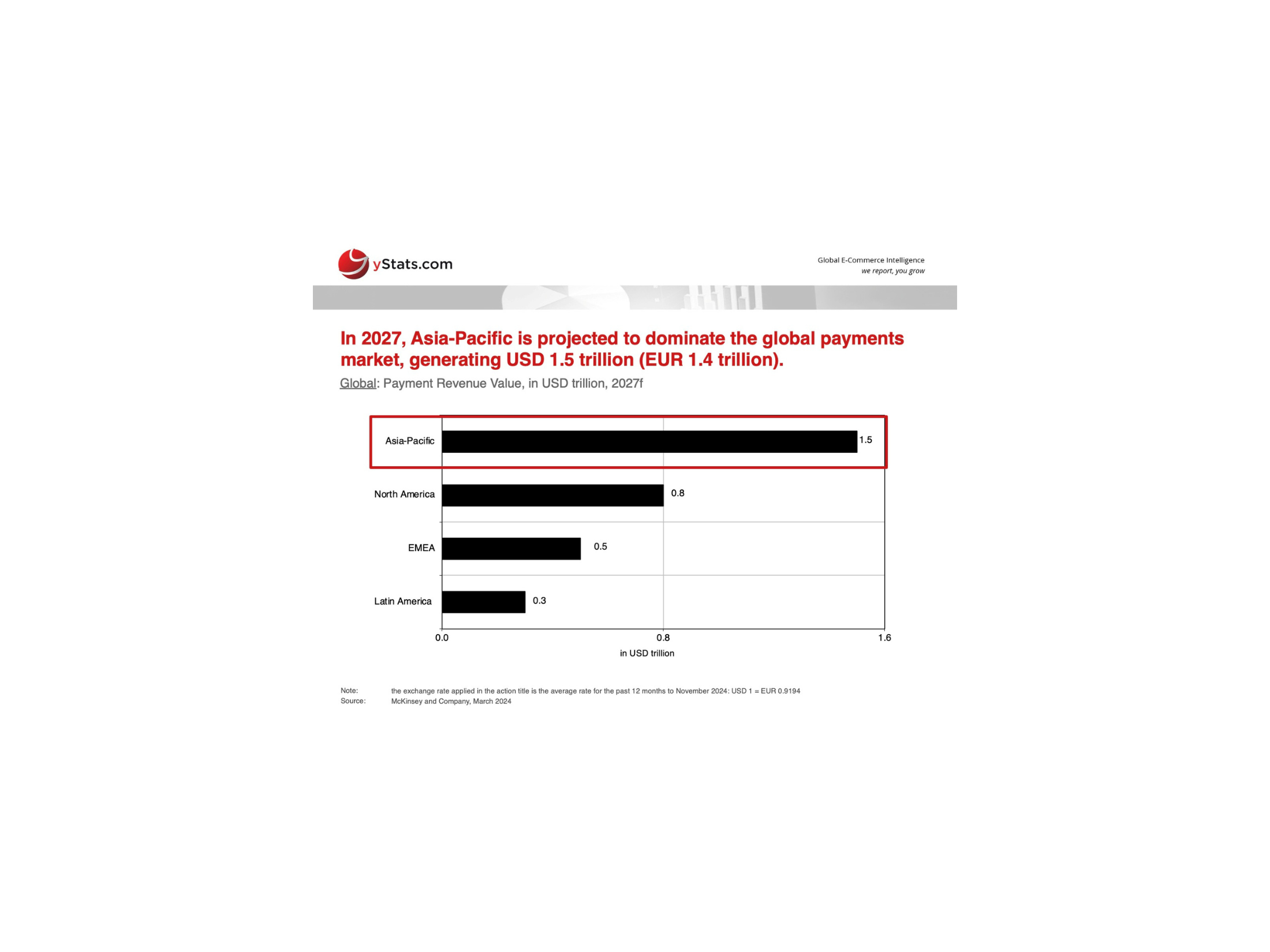
Asia-Pacific leads global payments growth in both volume and value. By 2027, the region is projected to generate approximately USD 1.5 trillion in payments revenue, accounting for nearly half of global payments revenue, as per McKinsey & Company. Mobile wallets and instant payment systems are widely adopted across major Asia-Pacific markets, supporting high transaction frequency and reinforcing the region’s position as the world’s largest digital payments market.
In North America and Europe, cards remain structurally central to the payments ecosystem. Card payments continue to dominate transaction value and revenue generation, supported by widespread merchant acceptance and entrenched consumer habits. At the same time, alternative payment methods such as account-to-account transfers and point-of-sale financing are gradually gaining relevance, contributing to a more diversified payments mix while cards retain a leading role.
In Latin America, the Middle East, and Africa, payments digitization is advancing rapidly as infrastructure expands and financial inclusion improves. In Latin America, account-to-account payment systems are playing an increasingly important role in digital commerce, while in the Middle East and Africa, non-cash transactions are scaling across both consumer and business segments. These regions continue to show strong growth potential as digital payment adoption extends beyond early adopters into broader populations.
AI Market Expansion Accelerates Across Commerce and Payments Through Rising Investment
Artificial intelligence is emerging as a fast-growing market segment within global commerce and payments, driven by expanding investment and rising market value. By 2031, the global value of AI in payments is projected to reach USD 60 billion, up from over USD 8 billion in 2023, according to Allied Market Research, reflecting rapid adoption of AI-enabled payment technologies across financial infrastructure. This growth underscores the increasing commercial importance of AI within digital payment systems.
Beyond payments, AI investment across financial services and digital commerce is scaling rapidly. The global AI in fintech market is expected to grow from more tha USD 18 billion in 2025 to over USD 50 billion by 2030, as per Mordor Intelligence, while the global generative AI market is projected to expand substantially over the same period. These trajectories highlight accelerating institutional investment in AI across transaction processing, financial services, and digital platforms.
Regional AI investment dynamics vary. In Southeast Asia, enterprises expect AI and generative AI to deliver cost reductions of 7–9% and revenue growth of 5–9% by 2027, reflecting growing confidence in business impact across markets, accorduing to BCG. In the Middle East and Africa, AI spending is forecast to increase rapidly through 2028, supported by public-sector investment and expanding digital infrastructure. In Africa, the AI market is projected to grow from nearly USD 5 billion in 2025 to over USD 16 billion by 2030, indicating early-stage but accelerating adoption across the region, according to Statista.
Conclusion
Global B2C E-Commerce, payments, and AI are evolving together as interconnected systems. Online retail continues to grow, but expansion is increasingly driven by transaction intensity as penetration stabilizes in mature markets. Payments are scaling rapidly through non-cash and instant methods, reinforcing their role as core digital infrastructure. At the same time, AI investment is accelerating across commerce and financial services, positioning AI as a growing market segment within the global digital economy. Together, these dynamics point to a digital commerce landscape that continues to expand in scale while transitioning toward deeper structural maturity.