From Open Banking to Open Finance: Building Connected Financial Ecosystems in 2026
Open Banking and Open Finance are moving financial-data sharing into a broader phase in 2026. While early Open Banking frameworks concentrated largely on customer-authorized access to bank-account information and payment services, emerging Open Finance models are widening this approach to additional areas of financial activity. Credit, investments, insurance, pensions, and business finance are increasingly entering the scope of data-access initiatives across selected markets. This expansion is also changing the infrastructure required to support financial-data exchange. APIs remain fundamental, but effective ecosystems increasingly depend on consent management, common standards, participant accreditation, interoperability, data quality, governance, and clearly defined responsibilities. Development remains uneven, however, with individual markets following different regulatory models and implementation timelines.
Reliable Infrastructure Requires More Than Standardized APIs
APIs provide the technical connections that allow authorized parties to exchange financial information, potentially reducing dependence on customized institution-by-institution integrations. However, common API standards do not automatically produce identical connectivity structures. Markets may rely on direct participant connections, intermediaries, aggregators, centralized hubs, or combinations of these models.
Performance is therefore an important part of infrastructure maturity. Data must be accessible consistently and delivered accurately and quickly enough to support financial services in practice. In the UK, Open Banking APIs recorded average availability and successful call rates above 99% in July 2026, according to Open Banking Limited. Such measures demonstrate how established ecosystems can increasingly be evaluated through operational reliability as well as the number of available connections.
Consent represents another essential component. Open Finance relies on customers authorizing access to their information, but jurisdictions differ in how permissions are granted, maintained, reconfirmed, and withdrawn. Canada provides for periodic consent reconfirmation, Malaysia applies different consent periods depending on the relevant use case, and UK Open Banking incorporates mechanisms for customers to view and revoke ongoing permissions.
Operational Adoption Is Expanding Across Markets
Comparing Open Finance adoption internationally remains difficult because markets use different measures of activity. Linked accounts, active users, consent requests, API calls, accredited participants, and successful data deliveries each describe different aspects of an ecosystem.
India's Account Aggregator framework demonstrates the scale permission-based financial-data infrastructure can achieve. By July 2026, Sahamati reported more than 325 million cumulatively linked accounts and over 530 million fulfilled consents. More than 340 million successful financial-information deliveries were also recorded during the month. These measures distinguish between connecting accounts, obtaining customer authorization, and actually transferring requested information.
Activity has also accelerated in New Zealand. Data-sharing requests increased from more than 9 million in May 2026 to just under 20 million in July, while accredited requestors increased from four at the end of 2025 to 14 by July 2026. Meanwhile, in the UK, more than 18% of people and small businesses with online current-account access were active Open Banking users in March 2025, compared with nearly 6% four years earlier, according to Open Banking Limited. Together, these examples indicate increasing operational use without implying that the markets have reached equivalent stages of development.
Financial-Data Sharing Moves Into More Financial Sectors
Traditional Open Banking has enabled services such as account aggregation, transaction analysis, payment initiation, and personal financial management. Open Finance extends the underlying principle of customer-permissioned access to a wider collection of financial products.
Wealth and investment services illustrate this widening scope. Standardized data connections can allow information on securities holdings, valuations, transactions, and customer portfolios to be accessed across multiple institutions. Brazil's Open Finance ecosystem has incorporated investment-related information, while initiatives in the UK are working toward standardized pension connectivity that could provide consumers with more consolidated views of retirement savings.
Insurance is also entering the Open Finance discussion, although progress differs significantly between markets. European initiatives have considered wider access to information associated with policies, premiums, and claims. Brazil has moved further operationally by incorporating insurance and private pension information into its wider data-sharing environment.
These developments suggest that Open Finance is increasingly being approached as cross-sector financial infrastructure rather than simply an extension of banking APIs.
Commercial Infrastructure Moves Beyond Account Connectivity
Commercial providers are similarly expanding beyond basic account aggregation. Platforms increasingly combine financial-institution connectivity with services including identity or account verification, data normalization, transaction enrichment, consent-based access, and payments.
Connectivity figures alone, however, can give an incomplete picture. A provider may connect with thousands of institutions without offering the same functionality through every connection. Payment initiation, transaction data, verification, enrichment, and recurring payment capabilities can differ substantially between markets and institutions.
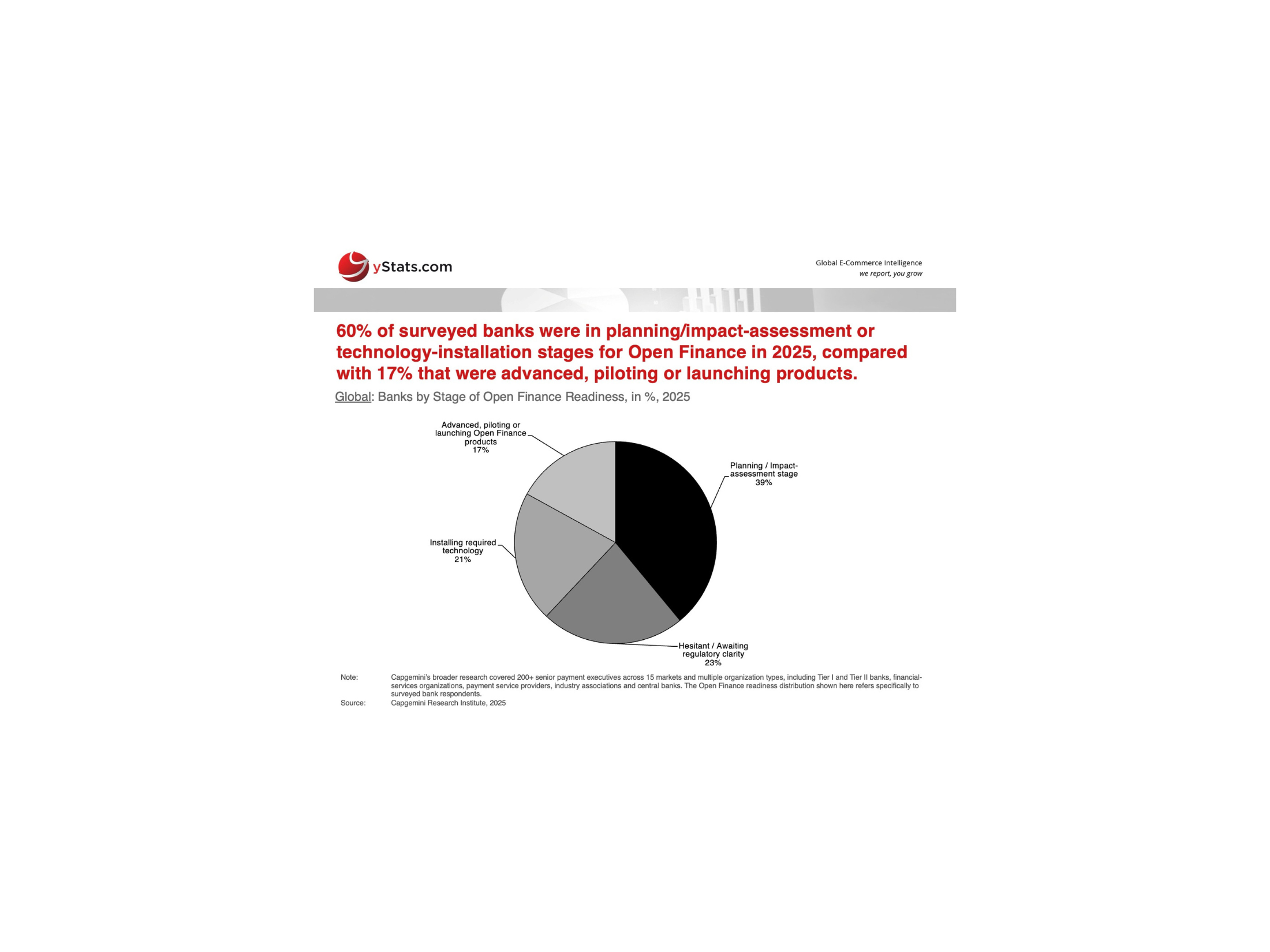
Implementation also remains a challenge. According to the Capgemini Research Institute, 60% of surveyed banks in 2025 were still at the planning, impact-assessment, or technology-installation stages of Open Finance, while fewer than 20% had progressed to advanced, pilot, or product-launch stages.
Regulatory Progress Remains Market-Specific
Regulation continues to develop at different speeds. New Zealand has entered regulated Open Banking implementation, while the UK is progressing toward a broader Open Finance environment through regulatory development and staged initiatives. In the EU, the proposed Financial Data Access framework remained under legislative negotiation in 2026, meaning broader cross-sector financial-data access had not yet become fully operational under that framework.
Differences are also evident across Asia-Pacific. By 2025, more than half of 16 assessed APAC jurisdictions had introduced Open Banking legislation, regulation, or guidance, according to the Cambridge Centre for Alternative Finance, while others remained at development or planning stages.
As more financial sectors become connected, governance requirements increase. Frameworks need to address accreditation, liability, data standards, oversight, customer protection, and the responsibilities of institutions and third-party data users. These issues become particularly relevant when a single customer interaction involves several organizations.
Open Finance Develops Into a Wider Infrastructure Layer
The development of Open Finance in 2026 points toward a financial ecosystem in which permissioned data access extends progressively beyond banking accounts. Investments, pensions, insurance, credit, and business finance are becoming part of a broader financial-data environment supported by APIs, consent mechanisms, standards, governance, and operational controls.
Yet this expansion remains fragmented. Regulation, technical architecture, available datasets, and commercial capabilities vary considerably between markets. The next stage of Open Finance will therefore depend not only on expanding access to financial information, but on building infrastructure capable of making that access reliable, secure, interoperable, and commercially workable. As agentic financial services develop, questions surrounding delegated permissions, authority, and accountability may further increase the importance of robust governance across these emerging ecosystems.