China, India & South Korea Advance Digital Commerce, Payments & Supporting Infrastructure in 2026
Digital commerce in China, India, and South Korea is increasingly supported by infrastructure extending beyond online marketplaces. Payment systems, digital wallets, cross-border connections, digital identity, financial-data services, and artificial intelligence are becoming more closely connected with how consumers discover products, complete purchases, and interact with financial services. Yet the three markets are not developing around a common model. China combines large commerce platforms with extensive wallet and QR-payment infrastructure, India links a growing online retail environment with UPI and digital public infrastructure, while South Korea pairs highly mobile shopping with card, payment-gateway, simple-payment, and digital identity services. These differences are creating distinct digital-commerce ecosystems across the three Asian markets.
AI Moves Further Into the Commerce Journey
Artificial intelligence is beginning to connect more directly with shopping and payments, although adoption remains at different stages. China already provides examples of AI being integrated with established commerce ecosystems. Alibaba connected Qwen with more than 4 billion products across Taobao and Tmall in May 2026, supporting conversational product discovery, comparison, ordering, and delivery management. Alipay has separately introduced AI Pay for payments through AI agents. Pasted text
India is developing an agentic UPI framework that could allow AI agents to make certain payments within user-defined limits and rules, with safeguards such as identity checks and audit trails under consideration. South Korea's NAVER has focused on AI-assisted shopping, adding proactive functionality to its Shopping AI Agent based on consumer shopping context.
These developments suggest that AI-commerce infrastructure is beginning to extend beyond recommendation toward purchasing and payment functions, while implementation and governance models remain in development.
Identity and Financial Data Become Part of the Supporting Infrastructure
Digital commerce is increasingly connected with infrastructure that operates outside the transaction itself. Identity systems can support authentication and access, while financial-data frameworks allow information to move between authorized participants. Developments in all three markets indicate that these capabilities are becoming part of wider digital financial ecosystems. Pasted text
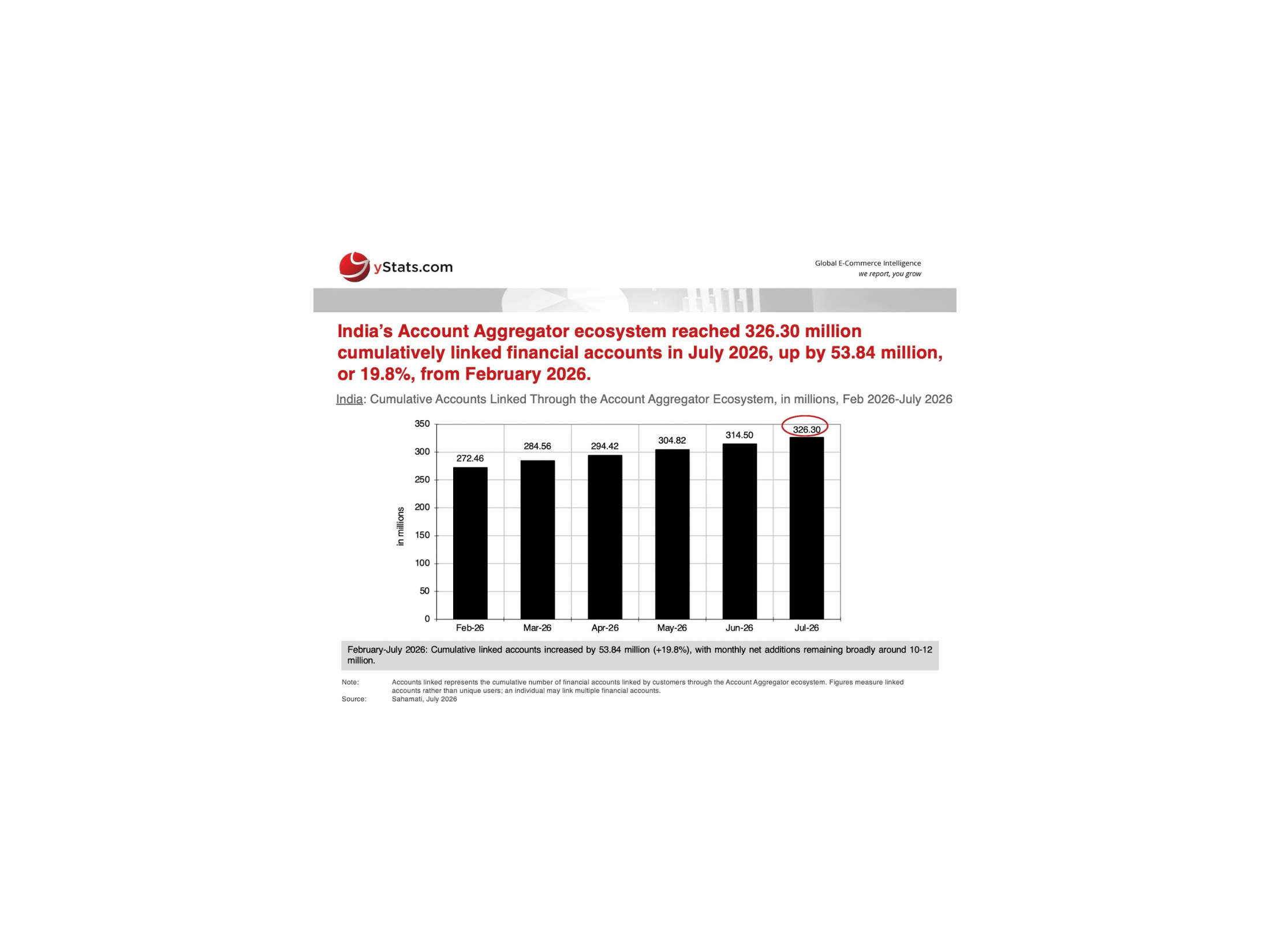
India combines Aadhaar-based authentication with Account Aggregator infrastructure for permissioned financial-data access. According to Sahamati, the Account Aggregator ecosystem had reached more than 325 million cumulatively linked accounts by July 2026. China is developing mobile authentication alongside broader data-infrastructure initiatives, while South Korea is expanding mobile identity and Financial MyData services.
The approaches again differ considerably. India combines nationwide digital public infrastructure with consent-based financial-data connectivity, while South Korea's Financial Services Commission has proposed expanding the information available through Financial MyData and introducing AI agents. China, meanwhile, is developing authentication and data infrastructure across public, financial, and commercial settings.
Online Commerce Develops Along Different Paths
E-Commerce remains an important part of consumer activity in each market, but purchasing patterns and platform structures vary. China maintains a large online retail environment spanning major marketplaces and increasingly integrated commerce services. India's market combines established E-Commerce with expanding Quick Commerce and Value Commerce models, while South Korea's online-shopping environment is particularly closely connected with mobile devices.
Consumer research illustrates some of these differences. According to S&P Global Market Intelligence Kagan, nearly 50% of surveyed internet adults in both China and India said they were buying more online in 2026 than in 2025, compared with over 30% in South Korea. The same research found that nearly 40% of surveyed internet adults in China bought mostly or primarily online, compared with over 30% in South Korea and 25% in India. These findings point to different purchasing patterns despite substantial digital-commerce activity across all three markets. Pasted text
Platform competition is also broadening. Chinese and Indian providers are extending their activities into Quick Commerce, while South Korean platforms increasingly combine shopping with membership, payments, and delivery. These developments are expanding the functions performed by commerce platforms rather than replacing conventional marketplace models. Pasted text
Domestic Payment Systems Support Different Commerce Environments
The payment infrastructure supporting digital commerce varies considerably by country. China combines bank and non-bank payments with mobile wallets, QR codes, payment platforms, and multiple clearing systems. India has developed UPI as a major connection between real-time bank payments and merchant commerce. South Korea, meanwhile, combines widespread card usage with payment gateways, prepaid electronic payments, simple payments, and remittance services. Pasted text
India illustrates the growing relationship between real-time payments and commerce. Person-to-merchant payments represented more than 60% of UPI transaction volume in FY 2025-26. UPI brings together banks, payment service providers, applications, consumers, and merchants while supporting payment methods including QR codes and intent-based transactions.
South Korea is following a different path toward digitally initiated payments, with the Bank of Korea reporting that simple-payment transaction value increased more than 15% year over year in H1 2026. China's infrastructure remains broader across bank, non-bank, wallet, and QR channels. The three markets therefore demonstrate how digital commerce can operate on payment systems with substantially different structures.
Payment Connectivity Increasingly Extends Across Borders
Domestic payment infrastructure is also becoming more internationally connected. China is expanding wallet interoperability and merchant acceptance overseas, India is extending UPI through international payment linkages, and South Korea is establishing cross-border QR connections. Rather than following one regional interoperability model, each market is extending existing domestic infrastructure through different arrangements. Pasted text
China's approach is closely linked with international wallet connectivity. Ant International reported that Alipay+ connected more than 1.8 billion user accounts across 40 international payment partners with merchants in more than 100 markets as of January 2026. Its infrastructure also connects with national QR systems and card networks, extending participating wallets into additional merchant environments.
India is expanding UPI internationally through initiatives including the real-time UPI-PayNow connection with Singapore and overseas merchant acceptance. South Korea launched QR payment connectivity with Indonesia in 2026 and has pursued connections with India and Vietnam. Collectively, these initiatives demonstrate how payment interoperability is becoming increasingly relevant to cross-border commerce and transfers.
Different Infrastructure Models Support a Broader Digital-Commerce Landscape
China, India, and South Korea illustrate three different approaches to connecting commerce with its supporting infrastructure. China's ecosystem combines large platforms with extensive wallet, QR, and international payment connectivity. India increasingly links E-Commerce and merchant payments with UPI, identity, and financial-data infrastructure. South Korea combines mobile commerce with cards, digital payments, identity services, and cross-border connectivity.
Across the three markets, the common development is therefore not convergence around one model. Instead, commerce is becoming more closely connected with payments, cross-border networks, identity, financial data, and AI through infrastructure shaped by each market's existing systems and priorities. Pasted text