Digital Commerce Infrastructure Developments Across Payments, Identity, AI, and Digital Money
Digital commerce infrastructure is becoming more interconnected in 2026 as payments, digital identity, artificial intelligence, digital money, and trust technologies increasingly operate within the same ecosystem. Financial institutions, payment providers, technology companies, merchants, and governments are modernizing the systems that support authentication, transaction execution, fraud prevention, settlement, and digital interactions. Rather than advancing independently, these capabilities are becoming interconnected layers of commerce infrastructure, supporting greater interoperability, automation, security, and resilience across domestic and cross-border environments.
Artificial Intelligence Expands Across Commerce
Artificial intelligence is becoming embedded throughout commerce infrastructure, supporting fraud detection, payment routing, customer authentication, compliance, treasury management, customer engagement, and operational automation. Financial institutions and payment providers are applying machine learning to analyze transactions, identify suspicious behavior, improve payment performance, forecast liquidity requirements, and reduce manual processes.
According to McKinsey, nearly 90% of respondents reported that their organizations regularly used AI in at least one business function in 2025. AI is also influencing consumer commerce through intelligent assistants, conversational interfaces, recommendation systems, and emerging agentic commerce capabilities. According to McKinsey, more than 60% of surveyed AI users use AI to compare brands, prices, and options. While autonomous transaction execution remains less developed, AI is already becoming an important layer connecting product discovery, identity, payments, fraud prevention, and customer experience.
Digital Money Broadens Settlement Options
Stablecoins, tokenized deposits, central bank digital currencies, and programmable payments are increasingly being explored as components of future commerce infrastructure. These technologies are developing alongside conventional banking and payment systems, with potential applications across commercial payments, treasury operations, liquidity management, and cross-border settlement.
According to Citi Institute scenario analysis, global stablecoin market capitalization could exceed USD 880 billion under a lower-growth scenario and approach USD 4 trillion under a higher-growth scenario by 2030. Financial institutions continue testing digital money applications while policymakers develop frameworks addressing reserves, transparency, supervision, and financial stability. The parallel development of stablecoins, tokenized deposits, and CBDCs suggests that multiple forms of digital money could coexist, increasing the importance of interoperability between emerging settlement mechanisms and established payment infrastructure.
Fraud Prevention and Governance Gain Importance
As commerce infrastructure becomes more connected, cybersecurity, fraud prevention, governance, and operational resilience are becoming increasingly important. Faster payments, digital identities, AI-enabled commerce, and programmable financial infrastructure introduce new capabilities while also creating additional risk-management requirements.
Organizations are combining identity verification, behavioral analytics, continuous authentication, transaction monitoring, and AI to identify suspicious activity earlier while limiting friction for legitimate customers. According to Juniper Research, global e-commerce fraud is forecast to rise from more than USD 40 billion in 2024 to over USD 100 billion in 2029. Governments and industry organizations are simultaneously developing frameworks covering payment modernization, digital identity, AI, digital money, and Digital Public Infrastructure. Governance and interoperability standards are therefore becoming increasingly connected with technological development and the ability to deploy emerging infrastructure securely at scale.
Payment Infrastructure Moves Toward Multi-Rail Ecosystems
Payment infrastructure is developing beyond traditional card-based models as real-time payments, account-to-account transfers, digital wallets, open banking, APIs, and payment orchestration become more closely connected. These capabilities increasingly coexist with established payment rails, allowing transactions to be routed according to factors such as speed, cost, customer preference, and operational requirements.
Modernization also includes standardized messaging, cloud-based platforms, API connectivity, and orchestration technologies that improve communication between payment systems. Cross-border infrastructure is developing in parallel as financial institutions, governments, and international organizations pursue stronger links between domestic networks. Together, these developments are moving payment ecosystems toward more interoperable, multi-rail infrastructure capable of supporting increasingly complex digital commerce.
Digital Identity Becomes a Core Trust Layer
Digital identity is expanding beyond conventional security functions to support onboarding, authentication, identity verification, authorization, and trusted access across payments, financial services, government platforms, healthcare, education, and enterprise environments. Passkeys, biometrics, digital credentials, identity wallets, and passwordless authentication are helping reduce friction while strengthening security. According to the FIDO Alliance, 75% of surveyed consumers globally had enabled passkeys on at least some accounts by April 2026.
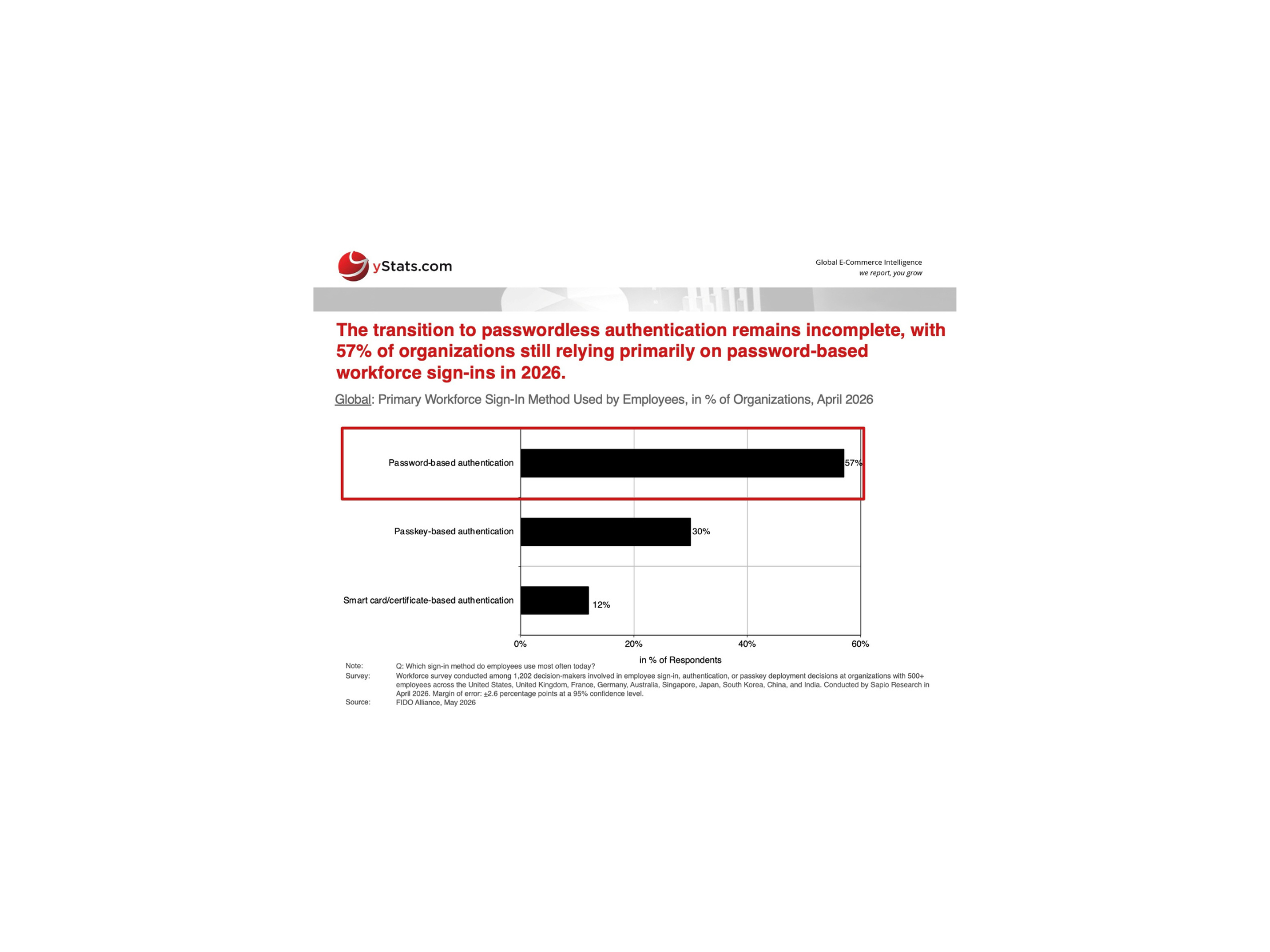
The transition away from passwords, however, remains incomplete. The FIDO Alliance reported that more than 50% of surveyed organizations still relied primarily on password-based workforce sign-ins, compared with 30% primarily using passkey-based authentication, as seen in the chart below. Identity infrastructure is consequently developing toward integrated models combining authentication, verification, credential management, governance, authorization, and fraud prevention throughout the digital customer lifecycle.
Regional Development Follows Different Paths
Digital commerce infrastructure is progressing differently across regions. North America continues investing in real-time payments, AI, and digital financial services, while Europe emphasizes instant payments, open banking, ISO 20022, interoperability, and the European Digital Identity Wallet. Asia-Pacific continues expanding real-time payment networks, digital identity ecosystems, mobile commerce, and Digital Public Infrastructure.
According to Capgemini Research Institute, Asia-Pacific non-cash transaction volumes are projected to exceed 2 trillion transactions by 2029, compared with approximately 700 billion in Europe and 373 billion in North America. Digital money development also varies by market. According to figures reported by the People's Bank of China, the e-CNY had processed more than 3 billion cumulative transactions worth over CNY 16 trillion by the end of November 2025. Latin America is expanding instant payments and financial inclusion, while the Middle East and Africa continue investing in payment connectivity, digital identity, tokenization, and financial infrastructure modernization.
Connected Infrastructure Shapes Digital Commerce
Digital commerce is increasingly defined by the interaction between payments, identity, AI, digital money, fraud prevention, and governance. As these capabilities become more integrated, infrastructure investment is shifting toward systems that support interoperability, scalability, resilience, automation, and trust. The continued development of multi-rail payments, trusted digital identities, intelligent commerce, programmable settlement, and coordinated governance is creating a more connected foundation for global digital commerce.