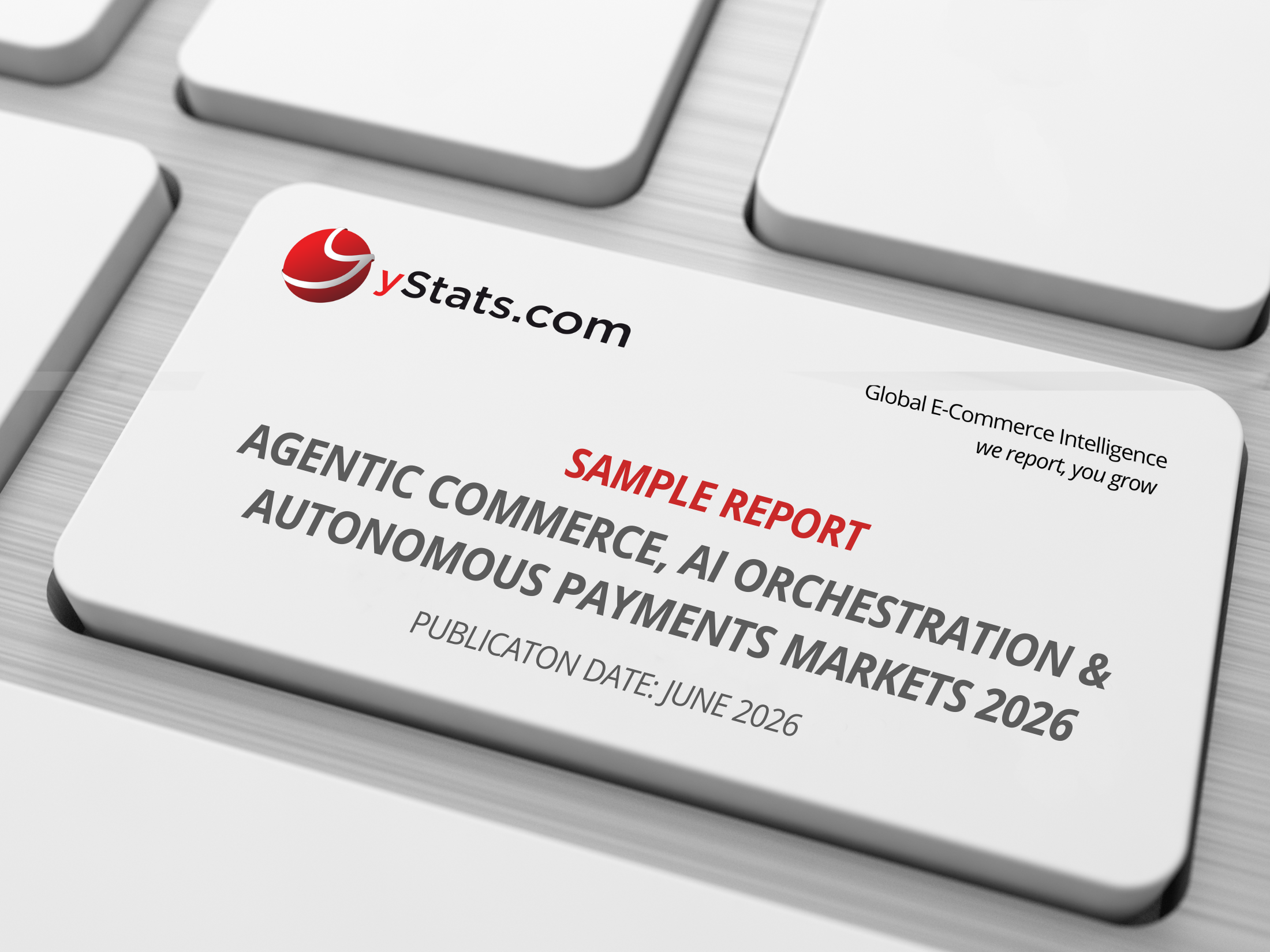
Sample Report: Agentic Commerce, AI Orchestration & Autonomous Payments Markets 2026
Hamburg-based secondary market research firm yStats.com analyzes the expansion of AI-assisted commerce, delegated purchasing systems, and autonomous payment infrastructure in its latest publication, “Agentic Commerce, AI Orchestration & Autonomous Payments Markets 2026.” The report examines how AI systems are becoming increasingly integrated into digital commerce ecosystems across product discovery, purchasing coordination, transaction execution, payment orchestration, fraud management, and digital identity infrastructure. It provides structured, source-based insights into agentic AI adoption, programmable payment systems, interoperable commerce infrastructure, governance developments, fraud prevention technologies, and competitive positioning across AI-mediated commerce ecosystems globally.
Description
Region: Global
Country: U.S., Canada, U.K,, China, Japan, South Korea, Saudi Arabia, UAE,
Pages: 167
Publication Date: 26.05.2026
Questions Covered in the report:
- How are AI-assisted commerce systems evolving from product discovery toward delegated purchasing and autonomous transaction execution globally in 2026?
- What factors are driving the expansion of payment orchestration layers and interoperable transaction infrastructure across enterprise commerce systems in 2026?
- How are AI-enabled phishing, deepfake fraud, synthetic identities, and automated social engineering attacks increasing fraud complexity across payment ecosystems globally in 2026?
- How widespread is mobile wallet adoption among consumers in China, and what does this reveal about the maturity of wallet-based payment ecosystems in 2024?
- What are the leading barriers to agentic AI adoption among U.S. enterprises in 2025, and how significant are cybersecurity and data privacy concerns?
Key Findings:
Global AI-Assisted Commerce and Autonomous Payment Infrastructure Expand as Agentic Systems Influence Digital Transaction Ecosystems
Why This Matters: AI-assisted commerce systems are increasingly evolving beyond recommendation and search functions toward broader participation across transaction coordination, delegated purchasing, and programmable payment environments. At the same time, payment ecosystems continue expanding interoperable infrastructure, real-time connectivity, and AI-compatible transaction systems, while governance, fraud prevention, and trust requirements remain central to broader adoption.
Key Highlights
• Globally, AI adoption among organizations using AI in at least one business function increased from over 50% in 2023 to more than 80% in 2025.
• In 2025, over 60% of global AI users relied on AI for product, brand, and price comparisons, highlighting expanding use of AI-assisted commerce environments.
• In the U.S., cybersecurity and data privacy remained the largest barriers to agentic AI adoption in 2025, cited by 35% and 30% of respondents respectively.
“What we are observing is the gradual expansion of AI-assisted transaction coordination across digital commerce ecosystems,” says Yücel Yelken, Founder and CEO of yStats.com. “Commerce infrastructure, payment systems, and digital identity frameworks increasingly support delegated purchasing, programmable authorization, and AI-compatible transaction execution, while governance, interoperability, and fraud prevention remain critical requirements for broader deployment.”
AI-Assisted Commerce and Delegated Purchasing Expand Across Digital Ecosystems
AI systems increasingly extend beyond recommendation and search tools toward broader participation across purchasing coordination, subscription management, and transaction execution workflows. Conversational interfaces, shopping agents, and AI-assisted customer journeys are becoming more integrated into digital commerce environments, contributing to broader automation across customer interaction and transaction coordination systems globally.
The report highlights that AI-mediated commerce environments increasingly influence merchant visibility, customer interaction, and transaction coordination across digital ecosystems. At the same time, fully autonomous purchasing remains constrained by trust, authentication, governance, and authorization limitations, with current adoption remaining concentrated in AI-assisted discovery and delegated purchasing environments involving continued human oversight.
Programmable Payments, Interoperability, and AI-Compatible Infrastructure Continue Expanding
Commerce ecosystems increasingly rely on interoperable APIs, orchestration layers, tokenized credentials, and machine-readable transaction environments to support AI-assisted coordination across purchasing and payment systems. Protocols including MCP, A2A, AP2, ACP, and Shopify’s Universal Commerce Protocol illustrate broader industry efforts to standardize AI-compatible commerce infrastructure.
Payment ecosystems continue evolving beyond traditional transaction processing models toward delegated authorization, programmable transaction execution, and multi-rail coordination systems. Real-time payments, tokenized settlement infrastructure, digital identity wallets, and interoperable payment systems increasingly support automated transaction coordination across cards, wallets, account-to-account systems, and RTP rails globally.
Fraud Prevention, Governance, and Infrastructure Competition Gain Strategic Importance
As AI-assisted commerce expands, organizations increasingly identify cybersecurity, authentication, privacy, and governance as major operational challenges across automated transaction environments. AI-assisted phishing, deepfake fraud, synthetic identities, and automated social engineering campaigns continue increasing operational complexity across digital payment ecosystems.
Financial institutions and payment providers increasingly deploy AI-driven fraud detection, biometric verification, behavioral authentication, and adaptive risk-scoring systems to strengthen transaction security and operational resilience. At the same time, regulators globally continue expanding governance frameworks surrounding AI-executed transactions, delegated authorization systems, and automated financial coordination environments.
Access the Full Report
For detailed insights into AI-assisted commerce systems, delegated purchasing models, programmable payment infrastructure, fraud prevention technologies, governance frameworks, and autonomous transaction ecosystems, access “Agentic Commerce, AI Orchestration & Autonomous Payments Markets 2026.” Please contact press@ystats.com for more information.
Table of Contents:
1. Key Takeaways
2. Management Summary
3. Global Executive Overview: From Digital Commerce to Agentic Commerce
3.1. Delegated and Autonomous Commerce Models
• Global: Evolution of AI-Assisted, Delegated, and Autonomous Transaction Models, May 2026
• Global: AI-Mediated Commerce, Delegated Purchasing, and Autonomous Transaction Execution, May 2026
• Global: Evolution from Assisted Discovery to Autonomous Purchasing Across the Commerce Journey, May 2026
3.2. Enterprise Adoption and Strategic Integration of Agentic AI
• Global: Organizations Using AI in at Least One Business Function, in % of Respondents, 2023 - 2025
• Global: Key Developments in Agentic and Generative AI across Banking Segments, May 2026
• U.S.: Current State of Agentic AI Technology Adoption Among Enterprises, in % of Respondents, Dec 2025
• U.S.: Share of Enterprises Rating Gen AI Tasks by Strategic Impact Level, in % of Resp., December 2025
• U.S.: Share of Enterprises by Level of Gen AI Task Autonomy, in % of Ent. Performing Each Task, Dec 2025
• U.S.: Share of Enterprises by Preferred Gen AI Platform Provider, in % of Respondents, December 2025
• U.S.: Enterprise Agreement with Select Statements on Gen AI Strategic and Risk Imp., in % of Resp., Dec 2025
• U.S.: AI Use in Finance by Function, Leadership Role, and Governance Priorities, May 2026
• U.S.: Leading Barriers to Agentic AI Adoption, in % of Respondents, 2025
3.3. Machine-Led Economic Coordination and Autonomous Systems
• Global: Autonomous Economic Agents and Machine-to-Machine Commerce Systems, May 2026
• Global: Shift from Payment Execution to Permission, Trust, and Programmable Transaction Logic, May 2026
3.4. AI Commerce Interfaces and Ecosystem Competition
• Global: Strategic Positioning Across AI Platforms, Payment Infrastructure, & Commerce Ecosystems, May 2026
• Global: AI Shopping Interfaces, Product Discovery Systems, & Commerce Integration Frameworks, May 2026
• Global: AI-Orchestrated Customer Interaction, Transaction Coordination, & Commerce Workflow, May 2026
4. Global Infrastructure Foundations for Autonomous Commerce
4.1. Real-Time Payments and Multi-Rail Transaction Infrastructure
• Global: Commercial Non-Cash Transaction Volume, in billions of Trans., and CAGR, 2018, 2021-2024f & 2028f
• Global: Real-Time Payments, Open APIs, Tokenization, and Interoperable Commerce Infrastructure, May 2026
• Global: Strategic Responses to A2A Payments and Multi-Rail Infrastructure Development, May 2026
• Global: Multi-Rail Payment, Orchestration Adoption, Infrastructure Positioning, and Revenue Models, May 2026
4.2. Wallet-Based and Tokenized Payment Ecosystems
• Global: Stablecoins, Tokenized Deposits, and Blockchain-Based Settlement in Payment Systems, May 2026
• U.S.: Digital Wallet Adoption Trends, May 2026
• Europe: AI Wallet Mergers, P2P Expansion, and Digital Euro Integration, May 2026
• China: Mobile Wallet Penetration, Digital Infrastructure, and Consumer Adoption, May 2026
4.3. Open Banking and Interoperable Commerce Infrastructure
• Global: Technology Foundations for Agentic Commerce, Protocols and Platform Integrations, May 2026
• Global: AI-Commerce Protocols and Interoperability Standards, May 2026
• Europe: AI in Open Banking for Risk Control, Value Services, and Infrastructure Efficiency, May 2026
• UK: Open Banking, API Ecosystems, and AI Payment Innovation, May 2026
4.4. Cloud Infrastructure and AI Compute Capacity
• Global: Cloud Infrastructure, AI Compute Scaling, and Commerce Processing Capacity Expansion, May 2026
• U.S.: AI Infrastructure Scaling and Investor Confidence, May 2026
• Europe: Cloud Dependency, Modular AI Architecture, and Strategic Investment Priorities, May 2026
• Africa: Digital Infrastructure, Data Center Expansion, and Governance Models for AI Deployment, May 2026
4.5. Merchant Infrastructure and AI-Compatible Commerce Execution
• Global: Merchant Readiness Across API Checkout and AI-Compatible Commerce Infrastructure, May 2026
• Global: Payment Processing Steps, System Dependencies, and Authorization Decision Layers, May 2026
5. Global AI Agents & Autonomous Commerce Systems
5.1. AI Shopping Agents and Delegated Purchasing Models
• Global: Autonomous Shopping Agents, Purchase Delegation, and AI-Assisted Commerce Workflows, May 2026
• Global: Conversational Commerce and AI-Assisted Purchase Journeys, May 2026
• Global: Agentic Commerce, Automated Payment Journeys, and Emerging Authentication Impli., May 2026
• U.S.: AI-Driven Shopping Capabilities, Virtual Card Integration, and Adoption Barriers in Payments, May 2026
5.2. Payment Routing and Automated Commerce Execution
• Global: Multi-Rail Payment Routing, Transaction Orchestration, and Automated Execution Infrastr., May 2026
• Global: Checkout Infrastr., Transaction Gateways, and Commerce Execution Layer Competition, May 2026
• Global: AI-Optimized Payments, Risk Management, and Customer Experience, May 2026
5.3. AI Automation in B2B Commerce and Procurement
• Global: Subscription Automation and Autonomous Recurring Commerce Models, May 2026
• Global: AI Procurement Agents and Autonomous Vendor Coordination Systems, May 2026
• Global: B2B Payments with Embedded Finance, APIs, AI, and Credit Tools, May 2026
• Asia: AI Applications in Credit Inclusion, Finance Automation, and Procurement Innovation, May 2026
• Asia: AI-Driven Cloud Banking, Investment Analytics, and Vertical B2B Financial Solutions, May 2026
5.4. Autonomous Commerce Applications Across Industry Sectors
• Global: Autonomous Commerce Use Cases Across Retail, Travel, and Digital Services, May 2026
• UAE: AI Integration Across Aviation, Retail, Financial Services, Logistics, and Telecommunications, May 2026
6. Global Payment Execution & AI Transaction Architecture
6.1. Delegated Payment Authorization and Spending Governance
• Global: Spending Thresholds, Approval Hierarchies, and Programmable Transaction Permissions, May 2026
• Global: Human Oversight, Consent Persistence, and Delegated Spending Governance, May 2026
• Global: Payments, Authorization and Agent-led Checkout, May 2026
6.2. AI Transaction Architecture and Digital Identity Infrastructure
• Global: AI Transaction Architecture Across Identity, Authorization, Payment, and Risk Infrastructure, May 2026
• Global: Agent Wallets, Persistent Credentials, and Portable Transaction Identity Infrastructure, May 2026
• Global: AI Use Cases in Tokenized Payments, Digital Identity & Agentic Commerce, May 2026
• APAC: AI-Powered Commerce Integration, Agent-Led Payments, & Payment Network Positioning, May 2026
6.3. Programmable, Tokenized, and Digital Payment Systems
• Global: Programmable Money Infrastructure Across Stablecoins, CBDCs, and Tokenized Payments, May 2026
• Europe: Digital Euro, MiCA Regulation, Innovation Framework, and AI-Driven Payments, May 2026
• APAC: AI Integration, Stablecoin Cards, Tokenised Transfers, and Micro-Merchant Access, May 2026
6.4. Cross-Border Payment Connectivity and Automated Transactions
• Global: Cross-Border RTP Connectivity, Interoperability, and Automated Payment Systems, May 2026
• China: Alipay and WeChat Pay Global Expansion and Cross-Border Usage Trends, May 2026
• Latin America: Cross-Border Payments and E-Commerce, May 2026
• Africa: Rising Remittances, Payment Inefficiencies, Stablecoins, and AI-Driven Financial Inclusion, May 2026
7. Global Identity, Trust & Authentication
7.1. Digital Identity Infrastructure and Trusted Verification Systems
• Global: Digital Identity Wallets, Verifiable Credentials, and Trusted Commerce Infrastructure, May 2026
• Europe: Authentication Integrat. into Payment Infrastructure Resilience & Cyber Risk Governance, May 2026
7.2. Behavioral Authentication and AI-Driven Fraud Prevention
• Global: Passive Verification, Behavioral Authentication, and Adaptive Transaction Trust Models, May 2026
• Europe: AI Fraud Prevention, Biometric Authentication, and Tokenized Checkout Solutions, May 2026
• Europe: Strong Customer Authentic., Fraud Reduction Effect, and Fraud Displacement Dynamics, May 2026
• Asia-Pacific: AI in Fraud Detection, Real-Time Payment Security, and Biometric Authentication, May 2026
7.3. Continuous Verification and Consumer Trust in Delegated Payments
• Global: Continuous Verification and Behavioral Signals as a Core Control Layer for Digital Fraud, May 2026
• Global: Consumer Trust, Authentication Friction, and Delegated Payment Acceptance, May 2026
8. Global Fraud, Abuse & Security Risks
8.1. AI-Driven Fraud and Financial Crime Risks
• Global: AI-Driven Fraud Escalation and Payment Fraud Values Despite Customer Authen., May 2026
• Global: AI-Enabled Phishing, Social Engineering Acceleration, & AI-Driven Fraud Det. in Payments, May 2026
• Global: Deepfake Fraud, Synthetic Identity Risks, and AI-Driven Financial Scam Activity, May 2026
• Middle East: GenAI in Fraud Detection, Risk, Customer Engagement, and Financial Automation, May 2026
8.2. Deepfakes, Synthetic Identity Fraud, and Verification Risks
• Global: Self-Reported Belief in Deepfake Identification Ability, in % of Respondents, 2024 - 2025
• Europe: Deepfakes, Synthetic Identities, and Onboarding Manipulation in AI-Driven Payments, May 2026
• APAC: Synthetic Identity Fraud, Deepfakes, Verification Gaps and Country Trends in FinTech, May 2026
8.3. AI-Based Risk Detection and Payment Security Controls
• Global: AI Transaction Accountability, Consumer Protection, and Delegated Payment Liability, May 2026
• Global: Real-Time Risk Scoring & Authorization-Stage Decisioning in Modern Payment Systems, May 2026
• Global: AI Applications in Payment Processing, Fraud Detection, and Operational Infrastructure, May 2026
• Global: AI in Transaction Monitoring, Identity Verification, and Payment Optimization, May 2026
• Asia: Cyber Defence, Identity Risk Management and Compliance Automation via AI, May 2026
• Middle East: AI-Powered Financial Threat Detection, TPRM Pilots, and Infrastructure Security, May 2026
9. Global Governance, Regulation & Legal Frameworks
9.1. Governance Frameworks for Autonomous Commerce and AI Transactions
• Global: Regulatory Challenges in AI-Executed Transactions and Autonomous Commerce, May 2026
• Global: AI Governance Challenges, Centralized Strategies, and Leadership Roles in Payment Firms, May 2026
• Europe: GPAI-Driven Consumer Risks from Accountability Gaps, Data Bias, and Manipulation, May 2026
• Europe: AI Act, Regulatory Sandboxes, Testing Environments, and Data Space Strategy, May 2026
• Latin America: Regulatory Gaps, Local Frameworks, Regional Coordination, and AI Governance, May 2026
9.2. AI Regulatory Sandboxes and Innovation Programs
• Asia: AI Sandboxes and Capacity-Building Programs in Four Economies, May 2026
• Asia: AI-Focused Regulatory Sandboxes and Innovation Hubs in Four Financial Markets, 2025 (1 of 2)
• Asia: AI-Focused Regulatory Sandboxes and Innovation Hubs in Four Financial Markets, 2025 (2 of 2)
• Latin America & The Caribbean: Responsible AI Initiatives, Policy Challenges, Regulatory Needs, and Data Governance Gaps, May 2026
9.3. AI Oversight, Transparency, and Compliance Requirements
• Global: Explainable AI and Model Governance Requirements in Financial Crime Analytics, May 2026
• Europe: AI Transparency, Third-Party Oversight, ICT Risk, and Ethical Use Requirements, May 2026
• Europe: GPAI Explainability Limits, ICT Risks, and Talent Shortages in Banking Sector, May 2026
• Europe: AI Act Risk Model, E-Commerce Adoption, and Early Implementation via AI Pact, May 2026
• APAC: Financial Crime Regulation, Synthetic Identity Laundering, and AI Compliance Strategy, May 2026
• APAC: AI Strategy in Anti-Financial Crime, Predictive Capabilities, and Governance Priorities, May 2026
• MENA: AI Regulation in Finance via Ethics Principles, Data Laws, and Innovation Sandboxes, May 2026
10. Regional Ecosystem Development
10.1. North America
• U.S.: AI Platforms, Payment Infrastructure, and Transaction Layer Competition, May 2026
• Canada: Organizational Measures Supporting Safe, Secure, and Trustworthy AI, in % of Resp., Sep - Oct 2025
10.2. Europe
• Europe: Trusted Identity Infrastructure, Interoperable Wallets, and Digital Verification Systems, May 2026
• Europe: AI-Driven Payment Automation, Fraud Detection, and Core Infrastructure Upgrades, May 2026
• Europe: AI-Driven MCA Growth, PSP Consolidation, and Regulatory Alignment via PSD3, May 2026
10.3. APAC
• China: Super Apps, Digital Wallets, and Integrated Commerce Infrastructure, May 2026
• Southeast Asia: Mobile Wallet Infrastructure and Embedded AI Commerce, May 2026
• Japan & South Korea: Trusted Automation and High-Tech Consumer Infrastructure, May 2026
10.4. Middle East
• MENA: AI-Driven Personalization, Risk Management, and National Investment in Financial Services, May 2026
• MENA: AI-Driven Personalization, Risk, Fraud Detection, and Compliance in Financial Services, May 2026
• GCC: AI Infrastructure Investment, Digital Economy Systems, and Commerce Modernization, May 2026
• GCC: AI Strategies, Infrastructure Development, and Capability Gaps by Maturity Segment, May 2026
• Saudi Arabia: GenAI Readiness, Infrastructure Scale-Up, and Sector-Specific Application Rollout, May 2026
• UAE: Government-Led AI Commerce Infrastructure and Smart Economy Development, May 2026
• UAE: Centennial 2071 Vision, Interagency AI Execution, and Adaptive Digital Regulation, May 2026
10.5. Latin America
• Latin America: FinTech Expansion and Commerce Automation Readiness, May 2026
• Latin America: Importance of Accessible Payment Options for Online Purchases, in % of Consumers Surveyed, 2025
• Latin America: FinTech Concentration & AI Readiness Potential by Country, in % of Total Fintech Comp., 2024
• Latin America: Blockchain Tokenization, AI Monitoring, and Customer-Centric Banking Innovations, May 2026
• Latin America: Fraud Challenges, Costs, AI Detection Tools, and Partnerships in Digital Payments, May 2026
• Latin America: AI Bills with Principle-Based Rights, Risk Classification, and Compliance Obligations, May 2026
• Latin America: AI Proposals with Governance Councils, Regulatory Sandboxes, and SME Support, May 2026
10.6. Africa
• Africa: Mobile Payments, Financial Inclusion, and Digital Transaction Infrastructure, May 2026
• Africa: Role of Payment System Architecture, Interoperability Models, and Integration Pathways in Shaping Mobile Payment Expansion, May 2026
• Africa: Expansion of Real-Time Payment Rails and Embedded Payment Models Across Commerce and Platforms, May 2026
• Africa: Cyber, Operational, Liquidity, and Execution Risks Shaping the Sustainability of Payments Growth, May 2026
• SSA: Fintech Innovation, National AI Strategies, and Global Partnerships in AI Adoption, May 2026
11. Global Competitive Landscape & Strategic Positioning
11.1. Competition Across AI and Commerce Ecosystems
• Global: Structural Winners and Vulnerabilities Across Agentic Commerce Ecosystems, May 2026
• Global: Winners in AI Platforms and Infrast. vs. Risks for Marketplaces and SEO-Driven Retailers, May 2026
• Global: Adoption of Model Context Protocol by Major Tech and Payment Platforms, May 2026
11.2. Strategic Partnerships Across AI, Payments, and Infrastructure
• Global: Strategic Partnerships Across AI, Identity, Payments, and Infrastructure Ecosystems, May 2026
• UAE: Strategic Partnerships, Scalable Infrastructure, and Innovation in National AI Landscape, May 2026
12. Global Future Outlook & Strategic Scenarios
• Global: Transition from Human-Initiated to Hybrid AI Commerce Models, May 2026
• Global: Long-Term Strategic Risks and Structural Implications of Agentic Commerce, May 2026
Compnies Mentioned:
- Amazon
- Shopify
- OpenAI
- Microsoft
- NVIDIA
- Apple
- Meta
- Mistral AI
- Amazon Web Services
- Alipay
- WeChat Pay
- Tencent
- Visa
- Mastercard